
by Angela
Share
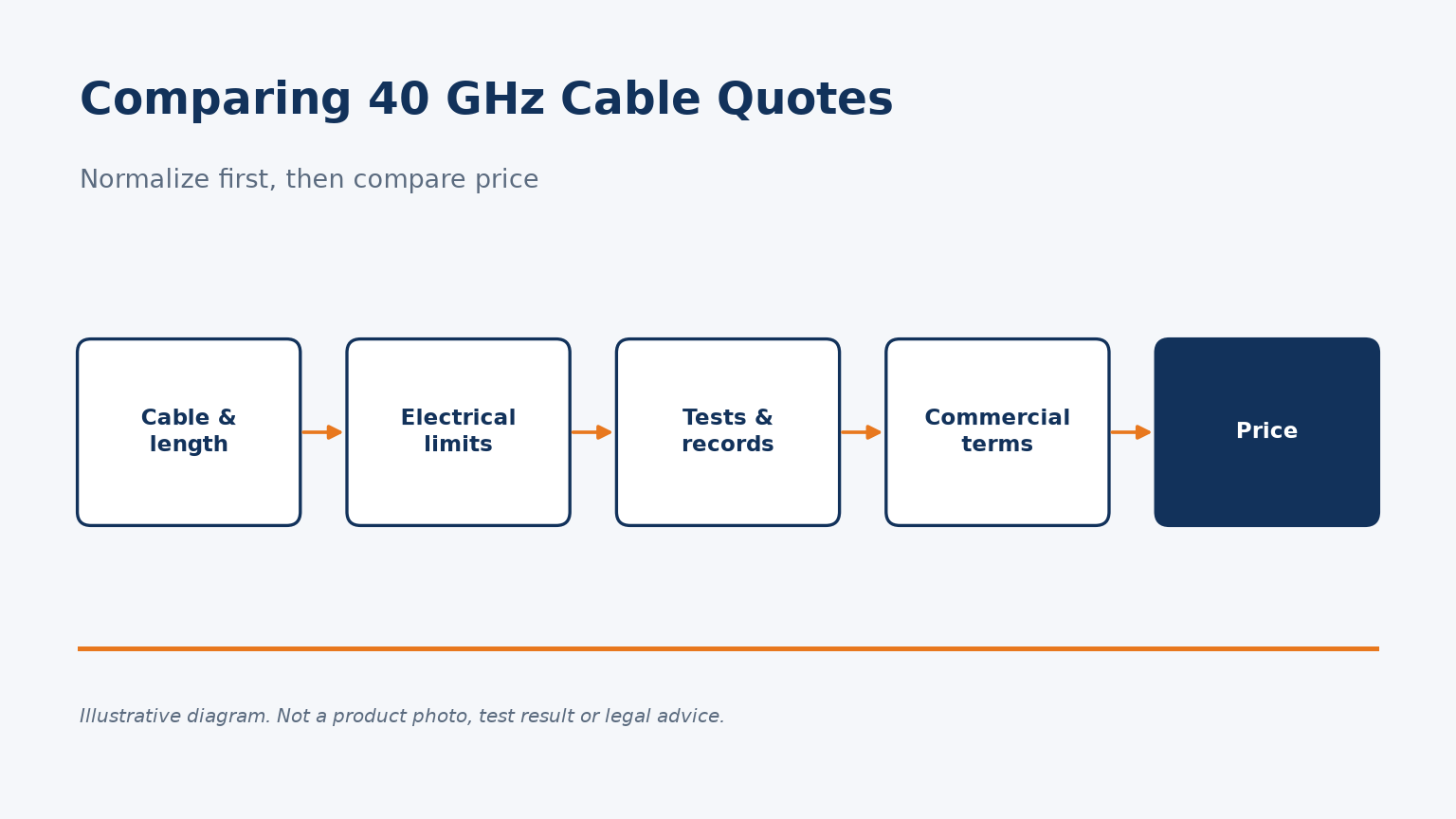
Comparing 40 GHz cable assembly quotes by price alone often means comparing different cables, tests and guarantees.
Compare 2.92mm cable assembly quotes only after normalizing cable type, length convention, guaranteed insertion loss and VSWR across your band, test scope and records, packaging, quantity and delivery terms. Price comparison comes last.
Below is the normalization method I use; if you have quotes in hand, send them with your band for a line-by-line review.
Why do two 40 GHz cable assembly quotes rarely describe the same product?
Two quotes for a "2.92mm cable assembly, 500 mm" can differ several times in price. Usually they are not quoting the same thing.
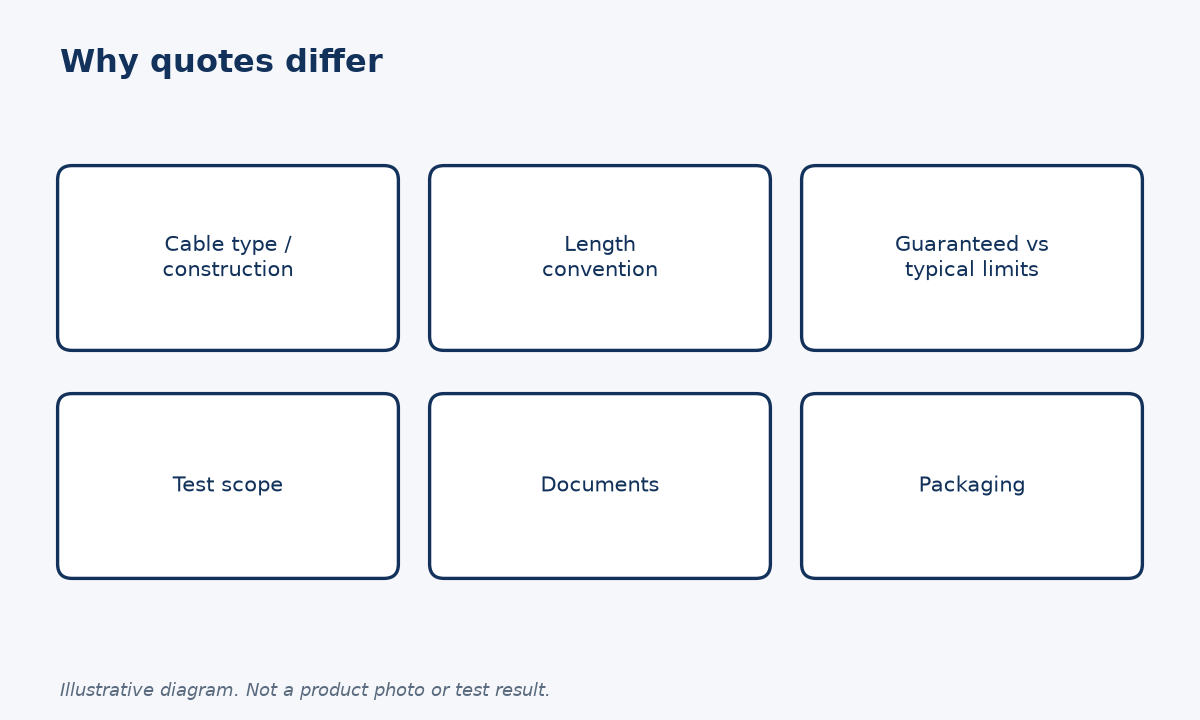
Quotes differ because suppliers fill unstated gaps differently: cable type, length convention, which limits apply across which band, what is tested and what documents ship. Normalize those items first; only then is a price comparison meaningful.
The hidden variables
At 40 GHz the cable itself drives much of the cost and performance. One supplier may quote a flexible test-grade cable, another a semi-rigid or hand-formable line, and both can honestly call the result a 2.92mm assembly. MIL-DTL-17, the general specification for flexible and semirigid RF cables, shows how many distinct constructions exist and why a named cable part number removes ambiguity.
Length is the next variable. "500 mm" may be measured tip to tip, between connector reference planes or along the cable only. Then come the electrical limits: is insertion loss specified at 40 GHz, or only typical? Is VSWR guaranteed across the band, or quoted at a few points?
My recommendation is to build a short normalization sheet before reading prices. List each supplier's cable, connectors, length convention, guaranteed limits and test scope side by side. Gaps in that sheet are questions to send back, not reasons to pick the cheapest line. For reference, our 2.92mm male to female assembly, DC to 40 GHz, 500 mm is built on RL3507 cable with stainless steel connector bodies; ask us for its guaranteed values at your band edge.
Which electrical terms must be normalized before comparing prices?
"Low loss" and "excellent VSWR" are not comparable terms. Numbers without conditions are not comparable either.
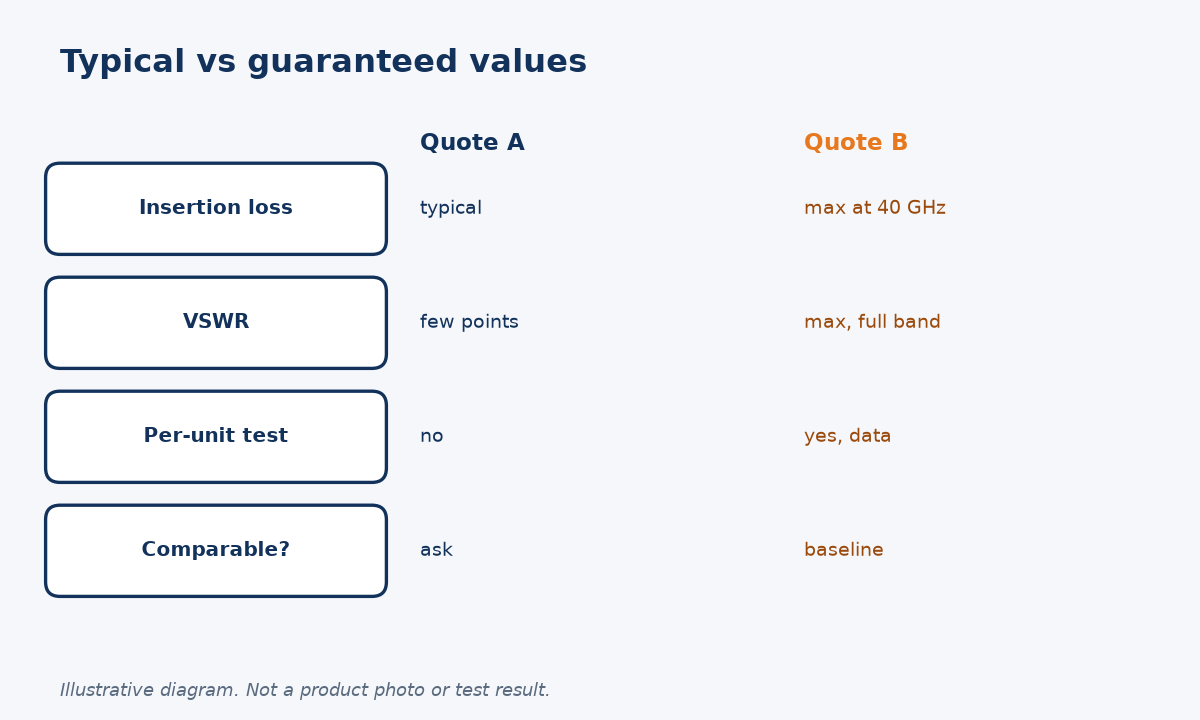
Normalize insertion loss (maximum, at which frequency, for which length), VSWR or return loss (maximum across which band), phase stability if needed, and whether each value is guaranteed per unit or typical. Convert all suppliers to the same units and conditions.
A normalization table
| Term | Normalize to |
|---|---|
| Insertion loss | Max dB at your top frequency, stated length |
| VSWR / return loss | Max across full band, one unit system |
| Phase / flex stability | Only if needed; state test method |
| Guarantee type | Per-unit tested vs typical |
The guarantee type matters most. A typical value describes the design; a tested maximum describes each part you receive. A quote with typical figures and no per-unit test can look better on paper and still deliver parts that vary. Ask each supplier to mark every number as either typical or tested maximum, and to state the length the loss figure refers to. Loss scales with length, so a figure quoted for a shorter assembly is not comparable with one quoted for yours, even when the cable is identical.
Test conditions also differ. NIST research on coaxial connectors (Lewandowski and Williams) identifies connector repeatability as the primary random error in coaxial S-parameter measurements, which means two labs can measure the same assembly slightly differently. Agreeing on torque, calibration and a retest rule for results near the limit removes most of that noise. If you want, send us both quotations with your band and we will tell you, line by line, what we would quote against each requirement.
What commercial and documentation terms change the real cost?
The lowest unit price can become the highest landed cost once samples, test data and lead time are added.
Compare minimum order quantity, sample and first-article charges, lead time for samples and production, test data delivered with each unit, connector protection and packaging, warranty terms, and Incoterms. Ask each supplier to state them explicitly.
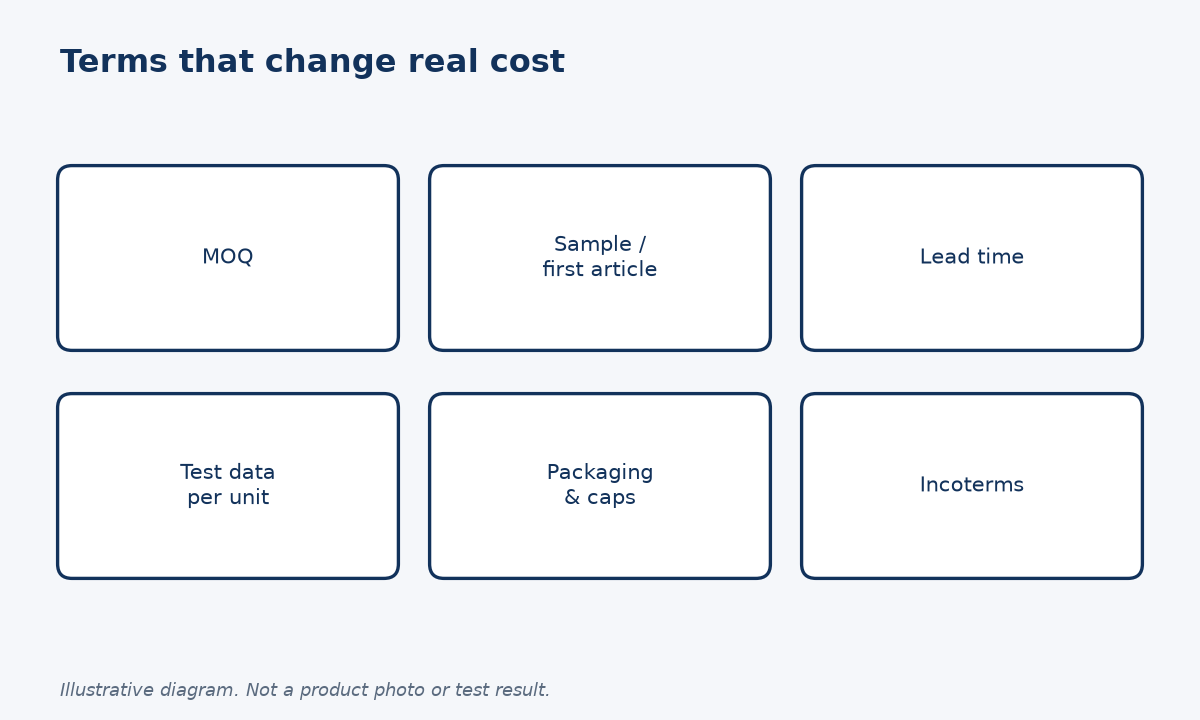
Terms that belong on the comparison sheet
Test records are a cost item, not a free extra. NASA's workmanship standard NASA-STD-8739.4A has acceptance test procedures available to the buyer for review and requires test records traceable to the specific assembly. Commercial buyers do not need the whole standard, but if you need serialized data or test plots, say so in the RFQ so every supplier prices it.
Packaging is another quiet difference at 40 GHz. 2.92mm interfaces are precision parts, and unprotected connector faces or tight coils in transit can damage them before first use. Ask whether dust caps and adequate bend radius in packaging are included.
Finally, put commercial terms in the same units: price per unit at your real quantity, the delivery term (EXW, FOB, DDP and so on), sample charges and lead time. I find that a quote which looks expensive often includes things the cheaper quote will charge for later. Normalizing these terms before negotiation keeps the discussion on substance rather than on surprises.
How should you request quotes so the next comparison is easy?
The easiest comparison is the one you designed into the RFQ before any supplier replied.
Send every supplier the same specification: connectors by series and gender, cable part number or performance class, length convention and tolerance, guaranteed electrical limits across your band, test scope and records, packaging, quantity and delivery term.
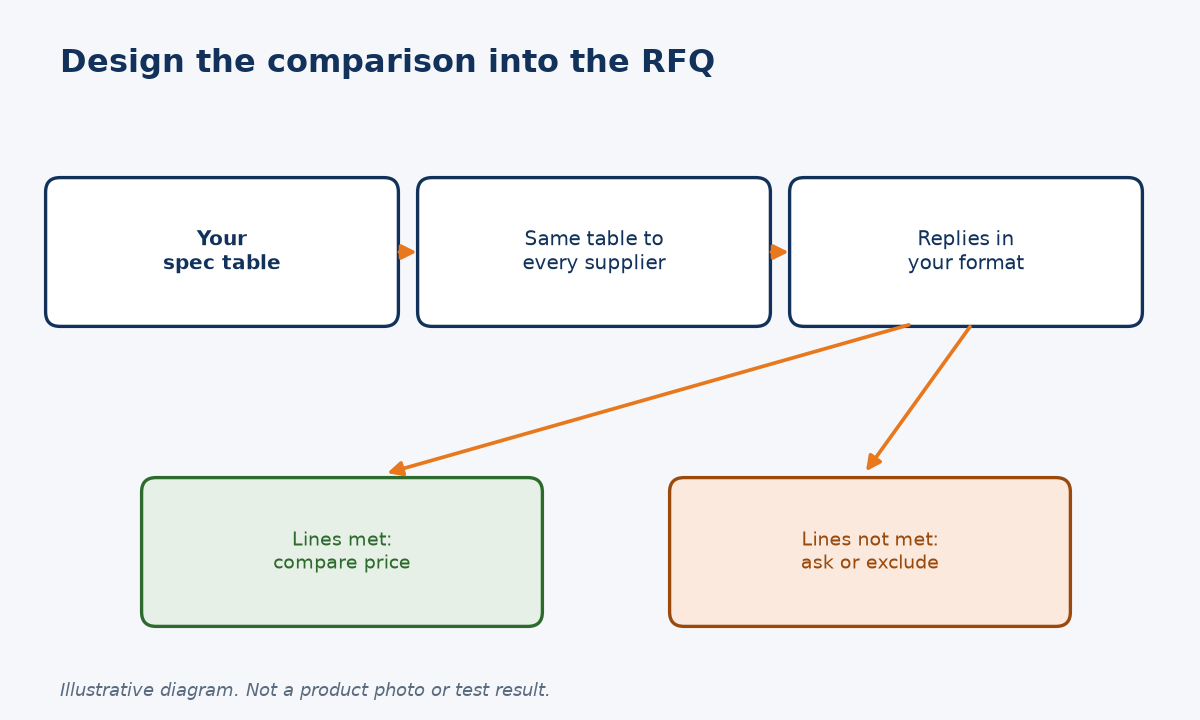
One spec, many suppliers
Interfaces should be named with reference to MIL-STD-348 series, such as 2.92 mm male to 2.92 mm female, so mating compatibility is not in doubt. If you accept alternative cables, state what must not change: impedance, maximum loss at your top frequency and minimum bend radius.
I also suggest asking every supplier to answer in your table format. It costs them little, and it removes the most time-consuming part of the comparison. Where a supplier cannot meet a line, they should say so rather than leave it blank.
Our earlier custom RF cable assembly quote checklist covers the general request; this article is about comparing replies at 40 GHz. When your specification is ready, request a quote from Reach-line. You can review the listed data on our 2.92mm 500 mm cable assembly page and ask for other lengths or connector combinations, which we will quote to your stated limits.
Conclusion
Normalize cable, length, guaranteed limits, tests and terms first. Then the lower price is genuinely the better offer.
STAY IN FOR MORE NEWS
Subscribe to our free newsletter.
What OEM buyers should specify for a hermetically sealed RF bulkhead adapter: leak-test method and limit, mounting, torques and records.
How to specify RF termination power for CW and pulsed signals: average vs peak, duty cycle, temperature derating, and an RFQ checklist.
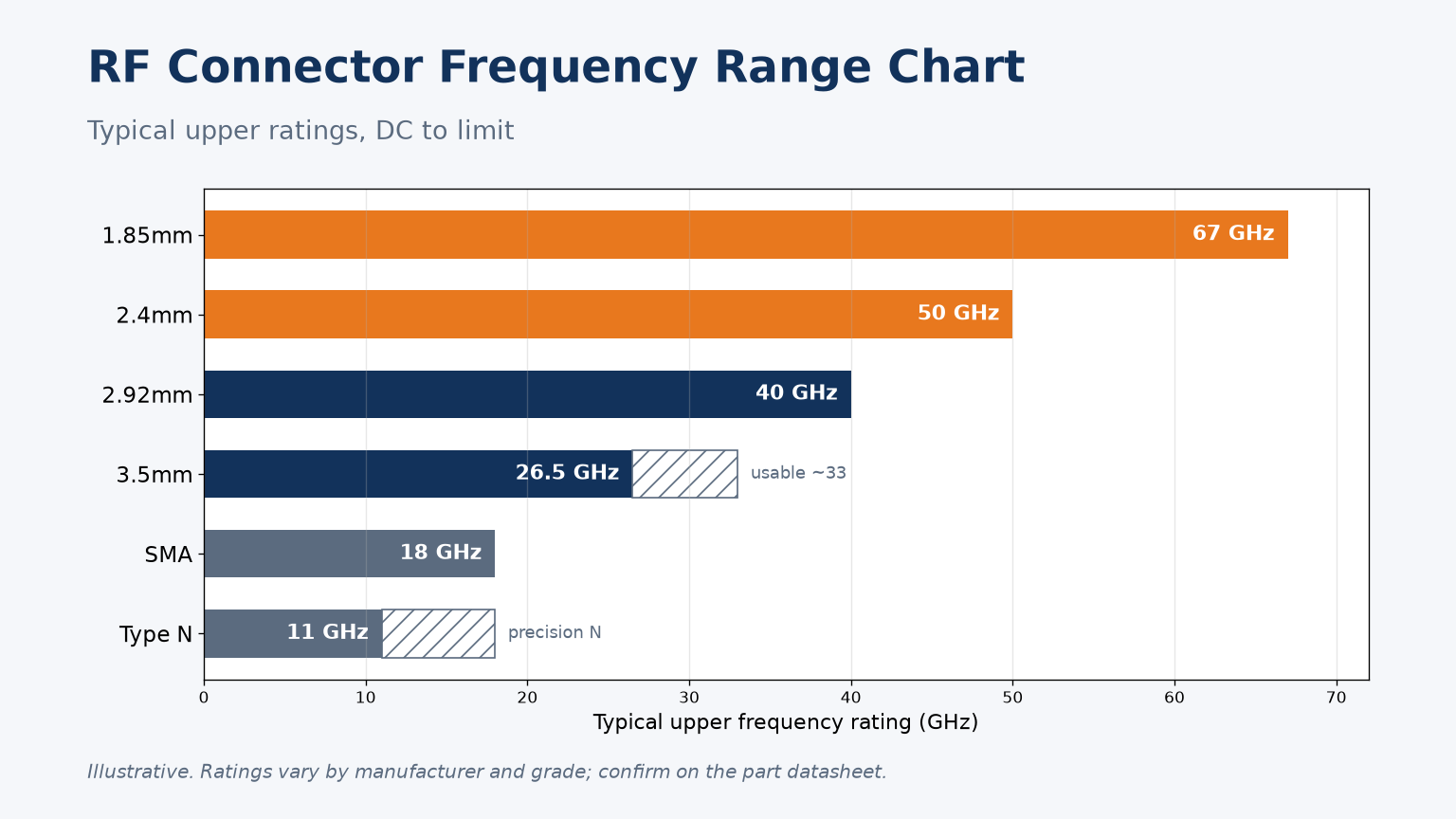
Frequency range chart for Type N, SMA, 3.5mm, 2.92mm, 2.4mm and 1.85mm connectors, why the limits exist, which ones mate, and how to specify a path.
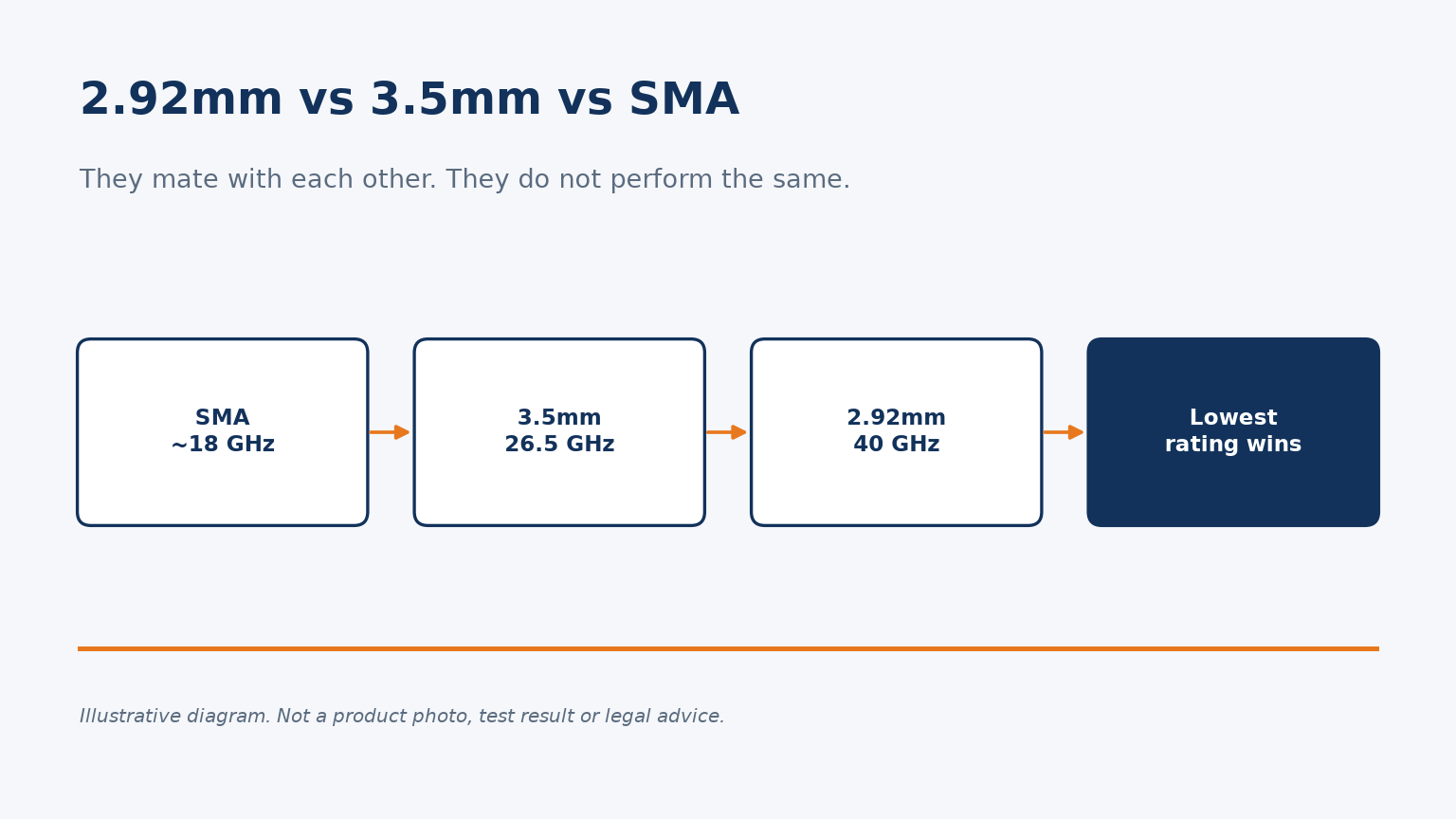
SMA, 3.5mm and 2.92mm connectors intermate, but not at the same frequency. Ratings, mixing rules, torque and when to choose each one.
