by Angela
Share
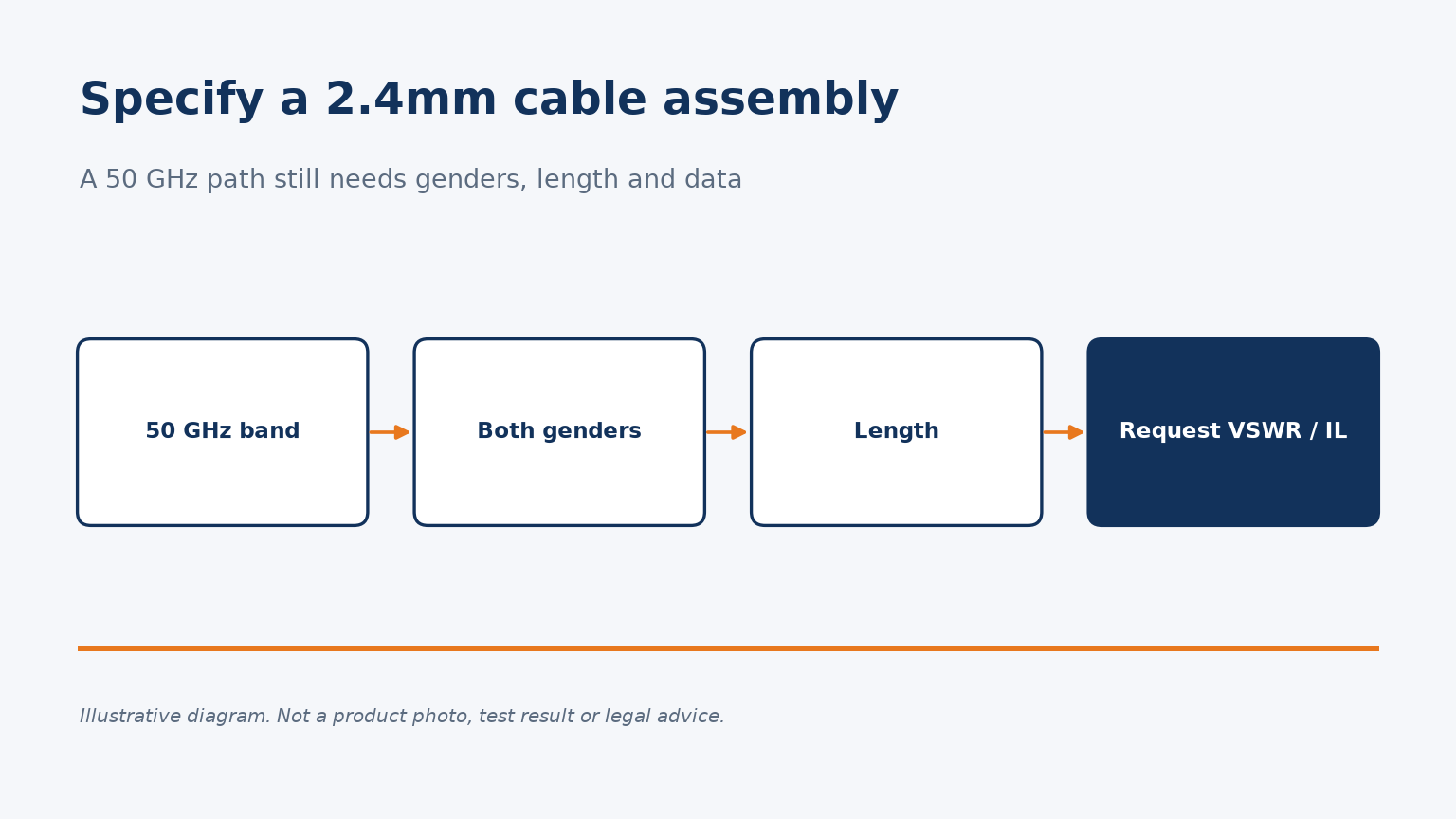
Writing only “2.4mm cable” leaves the band, both genders, the length and the loss data off the quotation, so two 50 GHz paths are not comparable.
Specify a 2.4mm cable assembly by the 50 GHz band unless a lower-rated face is in the path, both connector genders, the length, and the VSWR or insertion-loss data you need. Do not copy leftover 18 GHz or VSWR 1.20 attributes as the rating.
Below I walk through the band, the genders, the data you should request and a short RFQ; or send the two faces to us and we will help you turn them into a quote request.
What frequency should you write for a 2.4mm cable assembly?
The 2.4mm name points to a 50 GHz interface, but a mixed-interface cable that includes a 2.4mm face may be listed only to 40 GHz.
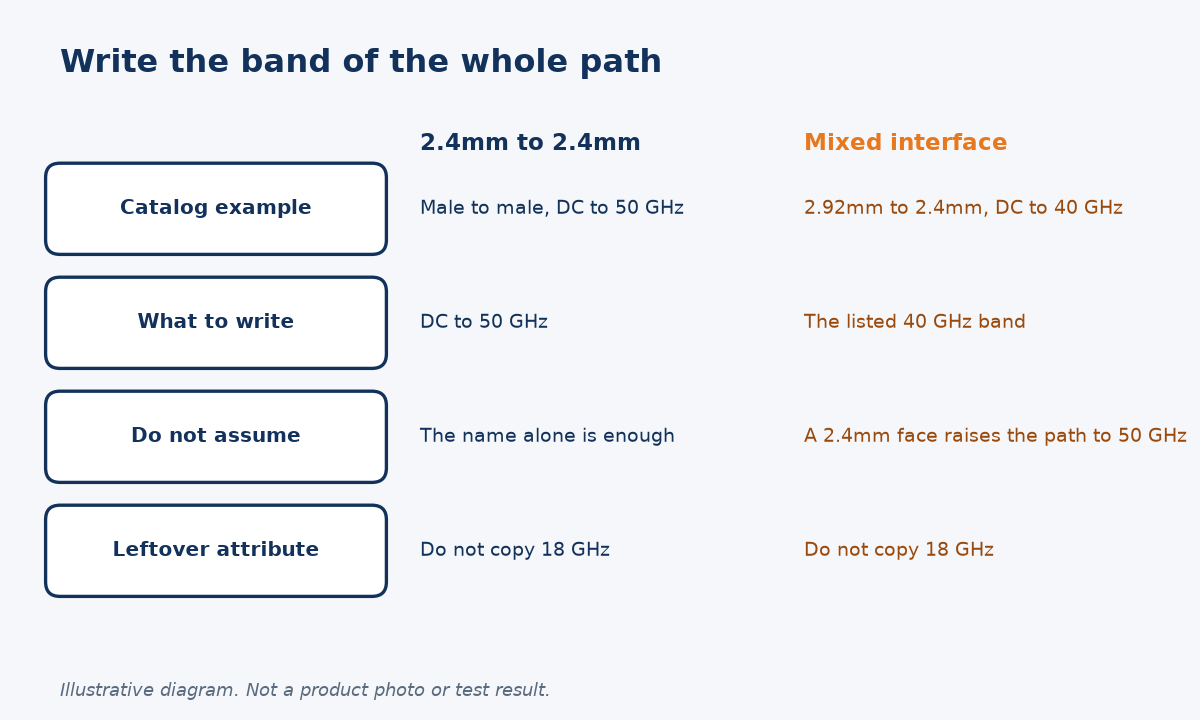
Write DC to 50 GHz when the path is 2.4mm to 2.4mm and that is the listed band. If one end is a lower-rated series, use the band published for that assembly; do not assume the 2.4mm name raises it to 50 GHz.
The interface rating is 50 GHz; the path may be lower
NIST Technical Note 2255 describes the 2.4 mm designation as an outer-conductor inside diameter of 2.4 mm and an inner-conductor outside diameter of 1.0423 mm, “with a specified upper-rated frequency of 50 GHz.” NIST also uses 2.4 mm airline standards for calibrations up to that frequency. That is the interface ceiling I start from. It is not, by itself, a VSWR or insertion-loss specification for a jumper.
Our catalog starting point is the 2.4mm male-to-male cable assembly, DC to 50G (P/N RL-2.4-3507-2.4-1000). The title and the technical data both say DC to 50 GHz. The same page gives 50 Ω, a temperature range of −55 °C to +85 °C, a durability of at least 500 matings, cable type RL3507, passivated stainless-steel bodies, gold-plated beryllium-copper contacts and PEI insulators. If that male-to-male 50 GHz path is close to what you need, open the product page and tell us the length and the faces.
A 2.4mm face on only one end does not automatically make the whole cable a 50 GHz path. The 2.92mm male to 2.4mm male cable assembly is titled DC to 40 GHz (P/N RL-2.92-3507-2.4-1000). A 2.4mm male to SSMP female assembly on the site is also titled DC to 40 GHz. Write the published band of the complete assembly. Our RF connector frequency range chart is the place to compare interface ceilings; this article stays on how to specify the cable.
Do not copy leftover Frequency 18G attributes from these pages into the RFQ. They conflict with the titles, and they are not the rating I use.
Why do both connector genders still have to be named?
The search phrase names one series, but a cable has two faces, and a male-to-male catalog example will not mate to two female ports.
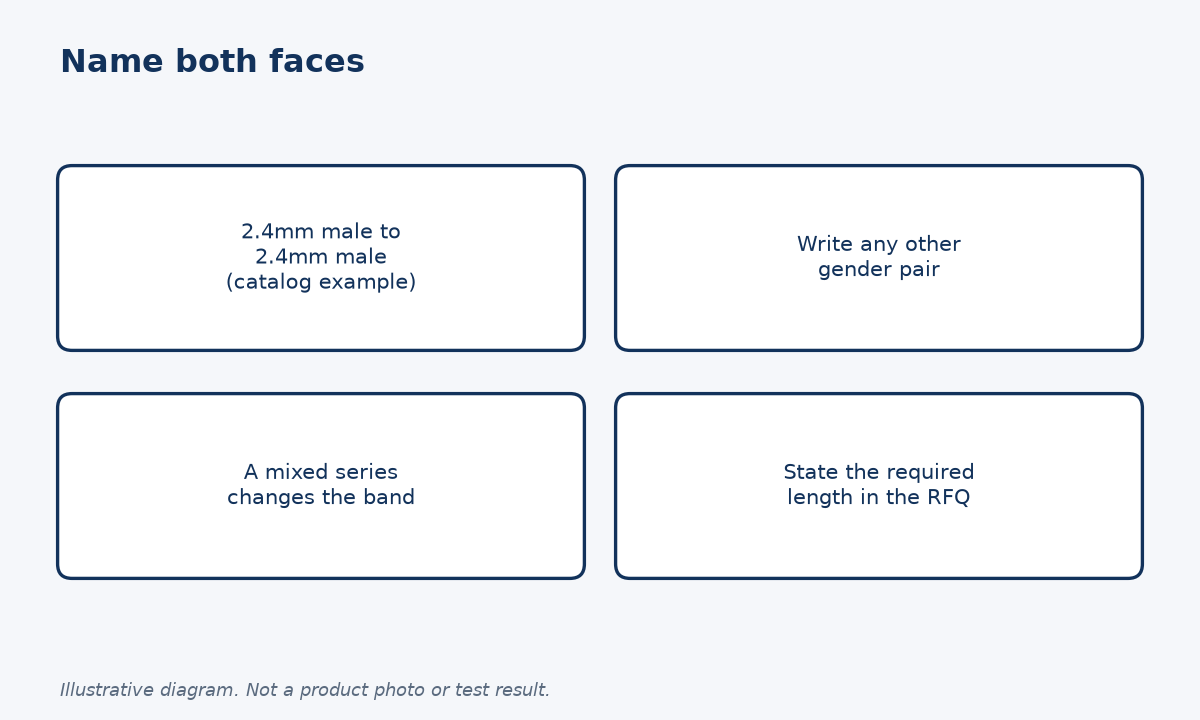
A 2.4mm cable assembly is specified by the series and gender on each end, not only by the words “2.4mm cable.” The catalog starting example is male to male; any other pair has to be written out, including a mixed series on one end.
Two faces, two gender choices
In coaxial hardware, “male” and “female” refer to the contact and the coupling interface. A 2.4mm female test port needs a 2.4mm male cable face; a 2.4mm male instrument port needs a female face. Writing only “2.4mm cable assembly” leaves those four combinations, plus any mixed-series option, on the table. A gender changer or an extra adapter adds a junction on a 50 GHz path, which is usually not what you want to discover after the cable arrives.
The listed starting part is 2.4mm male to 2.4mm male. If either port is female, say so. If one end must be 2.92mm, the catalog example is 2.92mm male to 2.4mm male, DC to 40 GHz; confirm both genders, and remember that this listing is a 40 GHz path, not a 50 GHz path. If you need a different gender pair than the one on that page, write both faces rather than assuming the published male-to-male pair can be flipped.
Length belongs on the same mechanical line. The catalog P/N is RL-2.4-3507-2.4-1000, but I treat the required length as an RFQ line rather than inferring it from the suffix. Quantity and the application should travel with that line so a quotation can be compared.
If you already know both faces, send the pair with the length. A 2.4mm cable assembly RFQ that names only the series is not yet a complete connector specification.
Why should VSWR and insertion loss be requested, not copied from leftover attributes?
The 50 GHz male-to-male listing does not publish a VSWR or insertion-loss figure in its description, and leftover attributes that say 1.20 are not a safe rating to copy.
Ask for the VSWR and insertion-loss data you need in the RFQ. Do not treat leftover VSWR 1.20 or Frequency 18G attributes as the assembly rating, and do not invent a number that is not in the description.
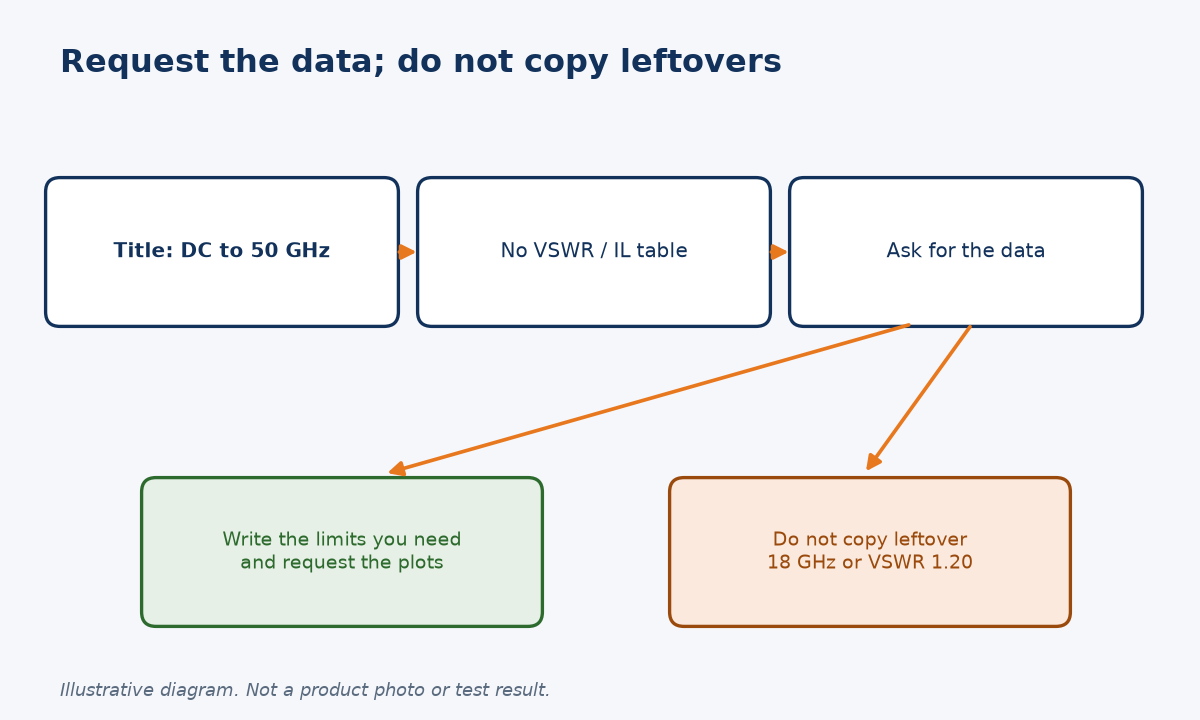
The description does not fill those two blanks
On the DC to 50 GHz male-to-male page, I do not find a VSWR or insertion-loss table in the description. Some leftover attributes still show Frequency 18G and VSWR 1.20. Those figures conflict with the title, and I do not quote them as the rating of a 2.4mm cable assembly. The honest move is to write the band from the title, then ask for the VSWR and insertion-loss data you will use to accept the cable.
NASA-STD-8739.4A sections 13.8.8 and 18.2.3 put exactly those tests on the engineering documentation: coaxial cables shall pass electrical requirements such as VSWR and insertion loss as specified there, and coaxial cable assemblies shall be given those tests as specified. NIST work on propagation delay is a reminder that electrical length and delay are also measured quantities, not something you can read off a leftover attribute.
If the 2.4mm path is being used next to a pad, the site also lists a 2.4mm fixed attenuator rated to 2 W or 5 W up to 50 GHz. That attenuator description table gives DC to 50 GHz and a VSWR of 1.3; I mention it only as a related 50 GHz component, not as a VSWR to transfer onto the cable.
This article is not a general custom-cable checklist and not a guide to comparing two 2.92mm, 40 GHz quotations; those are separate posts. The point here is narrower: on a 2.4mm, 50 GHz path, request the data, and do not fill the blanks from leftover attributes.
What belongs in a 2.4mm cable assembly RFQ?
Once the band, both faces and the data request are written down, the quotation can be compared from one supplier to the next.
A comparable RFQ lists the path band (50 GHz or the lower published band), both connector series and genders, length, quantity, the application, and the VSWR or insertion-loss data you want recorded. Send that list and our engineers will reply with a recommendation.
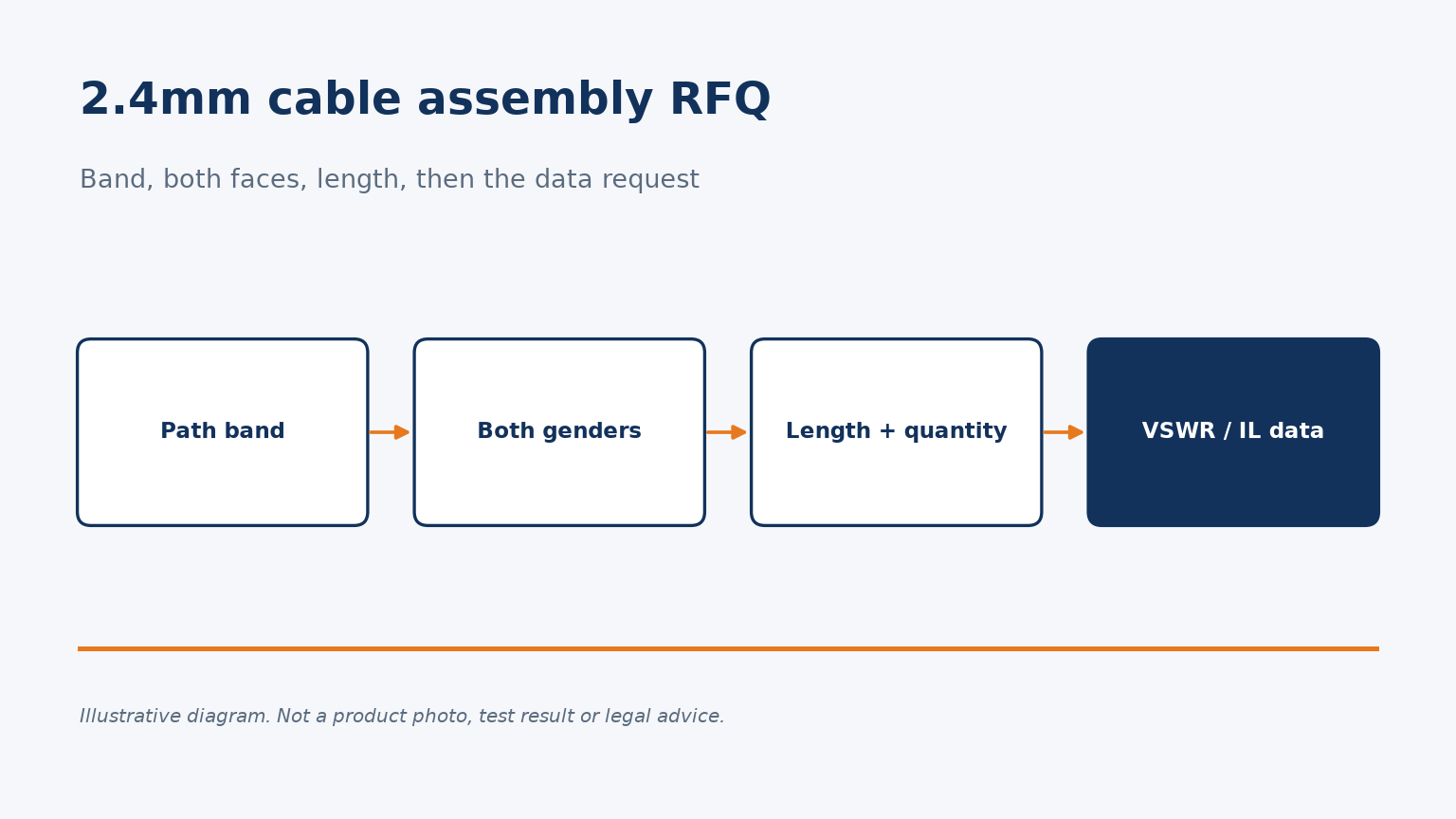
A short RFQ list for a 50 GHz path
I use the list below when a buyer wants a 2.4mm cable assembly quotation that does not depend on leftover attributes. The band line should come from the path you are actually buying. The connector line must name both ends. The data line is a request, because the 50 GHz catalog cable does not publish those figures in its description.
| RFQ line | What to state |
|---|---|
| Band | DC to 50 GHz for a 2.4mm-to-2.4mm path, or the listed band if one face is a lower-rated series |
| Interfaces | Series and gender on each end |
| Length and quantity | Required length, how many assemblies |
| Electrical data | 50 Ω if applicable; the VSWR or insertion-loss data you want recorded |
| Application | Where it will be used, and any temperature or handling note |
| Catalog example | P/N | Listed band | Notes for the RFQ |
|---|---|---|---|
| 2.4mm male to male | RL-2.4-3507-2.4-1000 | DC to 50 GHz | Request VSWR and insertion-loss data; do not copy leftover 18G / 1.20 attributes |
| 2.92mm male to 2.4mm male | RL-2.92-3507-2.4-1000 | DC to 40 GHz | A mixed-interface path; do not assume 50 GHz |
For a broader custom-cable list, use the custom RF cable assembly quote request checklist. If you are comparing two 2.92mm, 40 GHz quotations, use the quotation comparison article.
When the list is ready, request a quote and include frequency range, connector types and genders, quantity and the application, plus the VSWR or insertion-loss data you need. You can start from the 2.4mm male-to-male catalog page and tell us what must change. Our engineers will reply with a part recommendation; please confirm the band and both faces before you place the order.
Frequently asked questions
Is every 2.4mm cable assembly rated to 50 GHz? No. The catalog male-to-male assembly is titled DC to 50 GHz. Mixed-interface assemblies that include a 2.4mm face, such as 2.92mm to 2.4mm, are listed DC to 40 GHz. Write the band of the whole path, not only the 2.4mm name.
Why do some 2.4mm cable pages show 18 GHz or VSWR 1.20? Those figures look like leftover default attributes. They conflict with the DC to 50 GHz title and technical data on the male-to-male listing. Do not copy them as the rating; ask for VSWR and insertion-loss data in the RFQ.
How do I choose male or female on a 2.4mm cable assembly? Match each face to the port it must mate. The catalog starting example is 2.4mm male to 2.4mm male. If either port is female, or if one end is another series, write both genders and both series.
What else belongs in a 2.4mm cable assembly RFQ? State the length, quantity, the application, and the VSWR or insertion-loss data you want recorded. A general custom-cable checklist is a starting point, but it does not replace the 50 GHz band and the data request.
Conclusion
Name the 50 GHz band, both genders and the data you need; then a 2.4mm cable assembly quote is comparable.
STAY IN FOR MORE NEWS
Subscribe to our free newsletter.
Specify a 2.92mm attenuator from the 40 GHz part table: average power, dB value and table VSWR. See the 2 W to 50 W catalog options and an RFQ list.
A phase matched cable assembly RFQ should name frequency, the phase window, match method, connectors and length. See a 67 GHz catalog example.
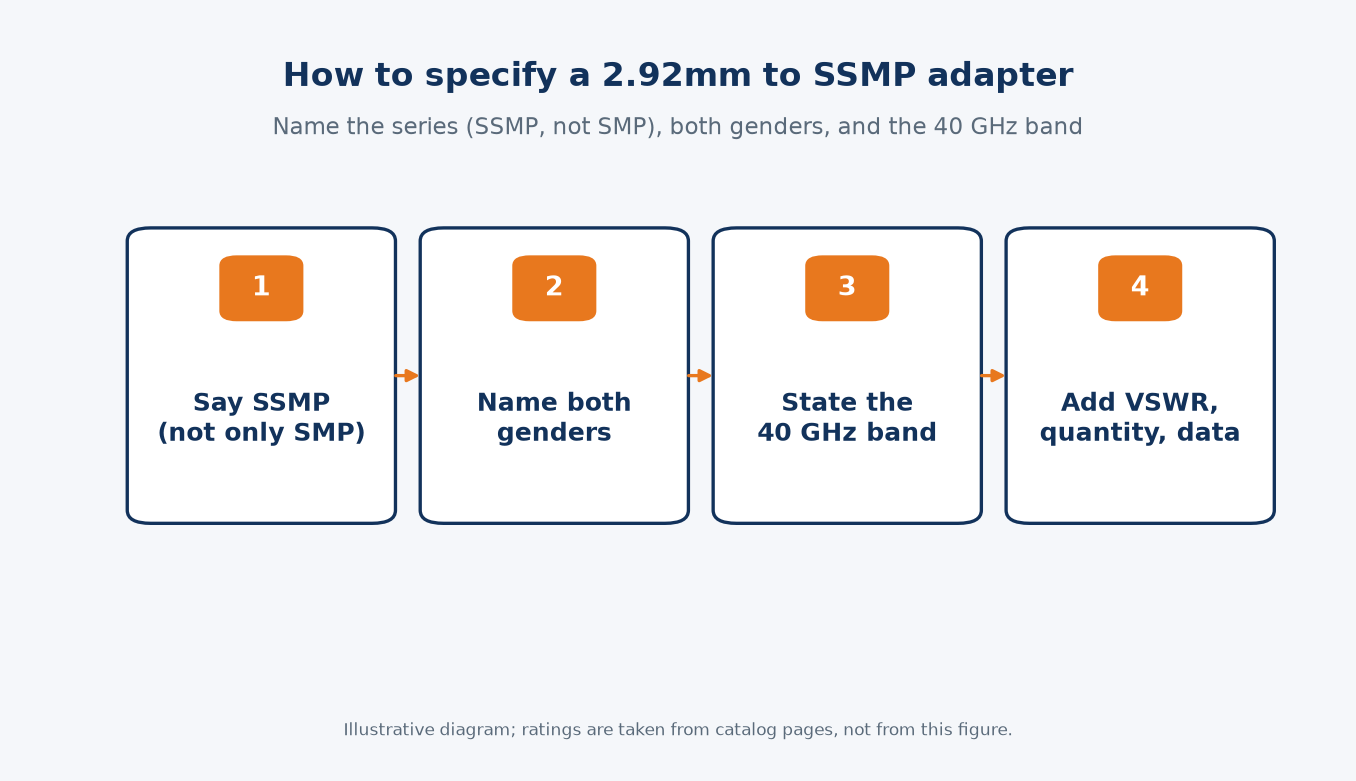
Specify a 2.92mm to SSMP adapter by both genders, 40 GHz band, and whether you need SSMP or SMP. See four catalog gender pairs and a short RFQ checklist.
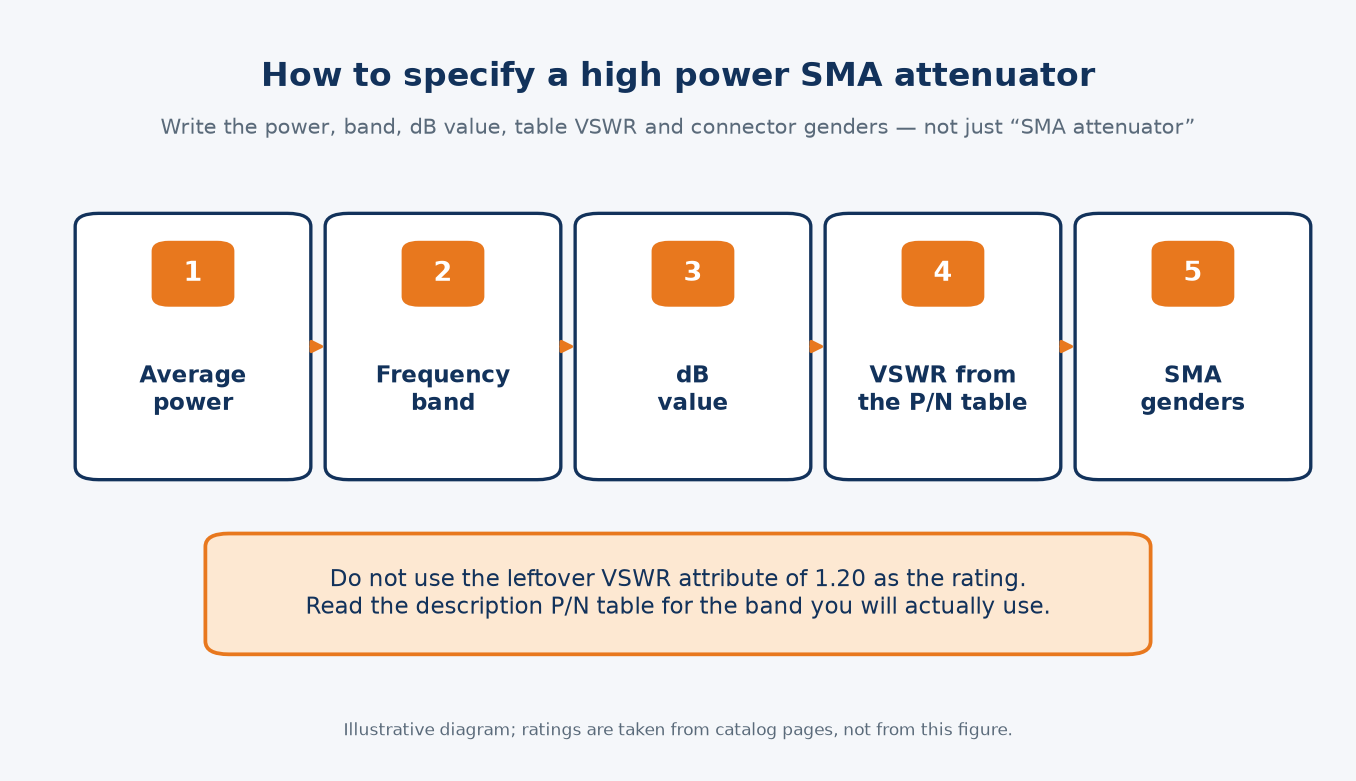
Specify a high power SMA attenuator by average power, band, dB value, VSWR and gender. See catalog 18 GHz options from 2 W to 50 W and an RFQ list.
