by Angela
Share
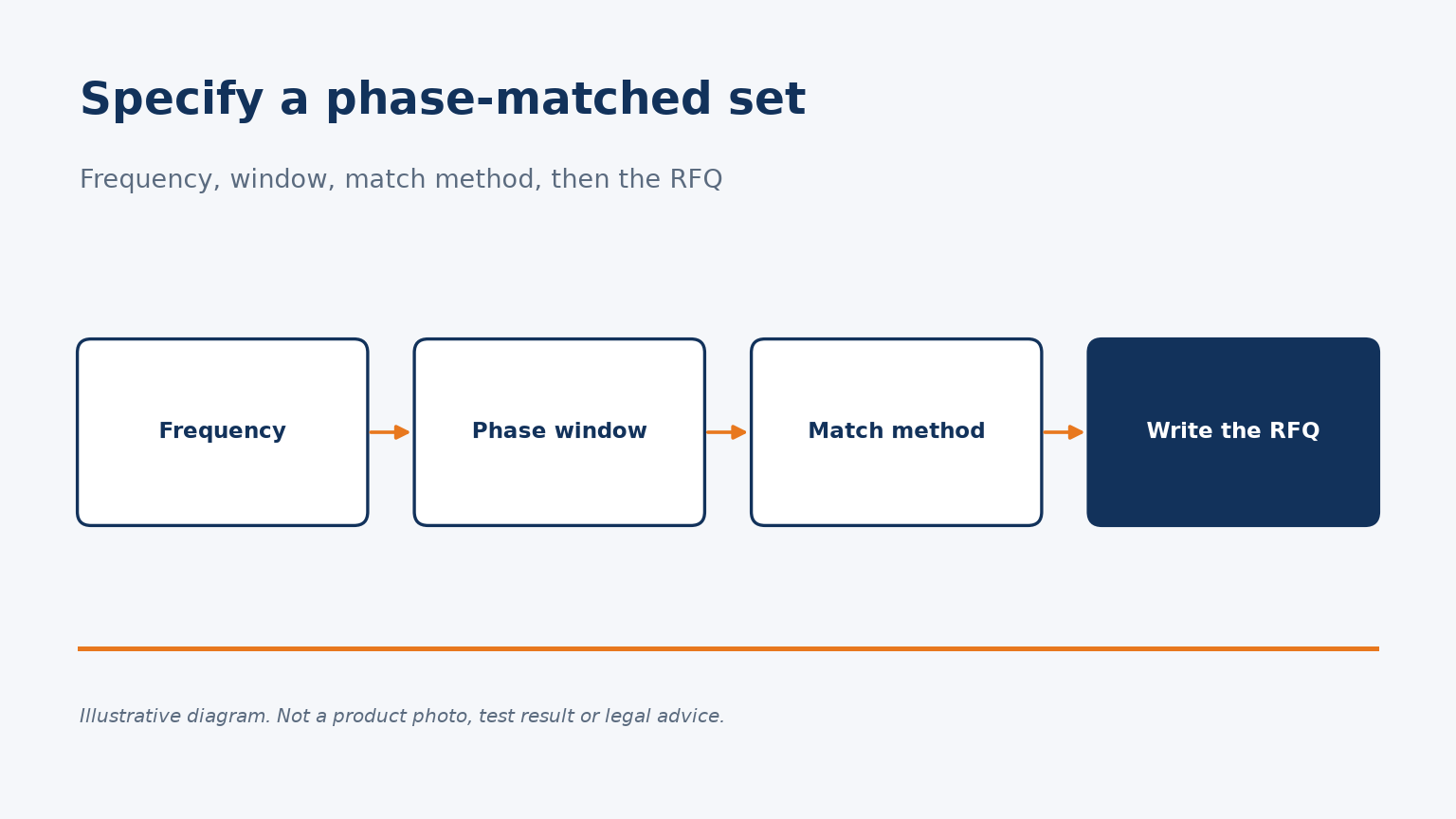
Ordering a “phase-matched cable” without a frequency, a degree window or a match method is how two quotations describe different assemblies.
A phase matched cable assembly RFQ should state the frequency at which the match is judged, the phase window in degrees, how the set is matched, both connector genders, and the length. The catalog 67 GHz example does not publish a degree tolerance, so you must write that window.
Below I walk through the window, the match method, the other electrical lines and a short checklist; or send the requirement to us and we will help you turn it into a quote request.
Why do frequency and a phase window both belong in the RFQ?
Phase in degrees is not a single property of a cable; it is a reading at a frequency, so a window without a frequency is incomplete.
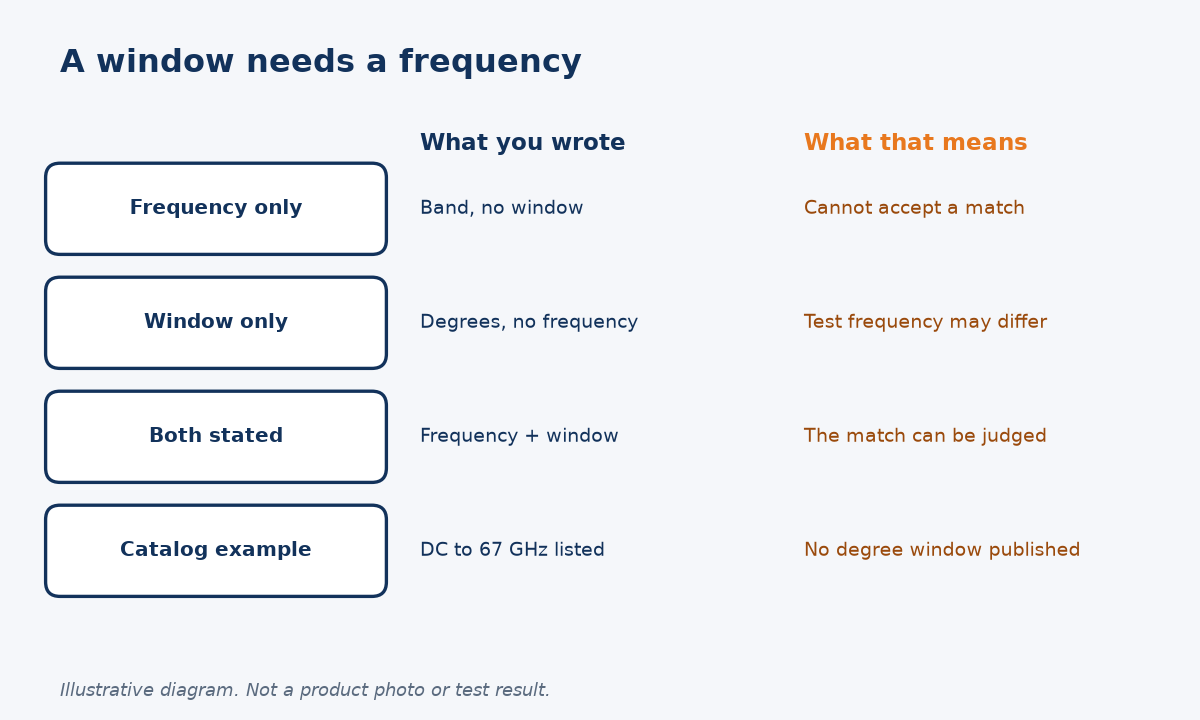
You need both the frequency at which the match is judged and the allowed phase window in degrees. A phase matched cable assembly cannot be accepted against a window that was never stated, and the catalog 67 GHz listing does not fill that gap.
The window has to be judged at a stated frequency
A coaxial assembly has a physical length you can measure with a ruler, and an electrical length that depends on how the signal travels in the cable. NIST work on propagation delay treats that delay as a measured quantity: it is the physical length divided by the group velocity, and it can be determined by pulse methods or by phase-shift methods. I start from that distinction because a phase window in degrees is a statement about electrical length at a frequency, not a substitute for “make it 1 m long.”
If you write only “phase matched” or only a degree window with no frequency, two suppliers can test at different points in the band and still claim they met the note. If you write only “DC to 67 GHz” with no window, they have a band but no match limit. Both lines have to appear together.
We list one catalog assembly that is explicitly named phase-matched: the 1.85mm male-to-male phase matched cable assembly, DC to 67 G (P/N RL-1.85-405-1.85-1000). The page gives 50 Ω, a frequency range of DC to 67 GHz, a temperature range of −55 °C to +85 °C, a durability of at least 500 matings, cable type RL405, passivated stainless-steel bodies, gold-plated beryllium-copper contacts and PEI insulators. It also lists a VSWR attribute of 1.45. It does not publish a phase-match window in degrees. I do not invent one.
If that 67 GHz male-to-male example is close to the path you need, open the product page and tell us the frequency and the window to hold. A phase matched cable assembly quote is only comparable once those two lines are written down.
Should the cables be matched to each other or to a stated electrical length?
Two assemblies can be close to each other and still be far from a stated electrical length, so the match method has to be named.
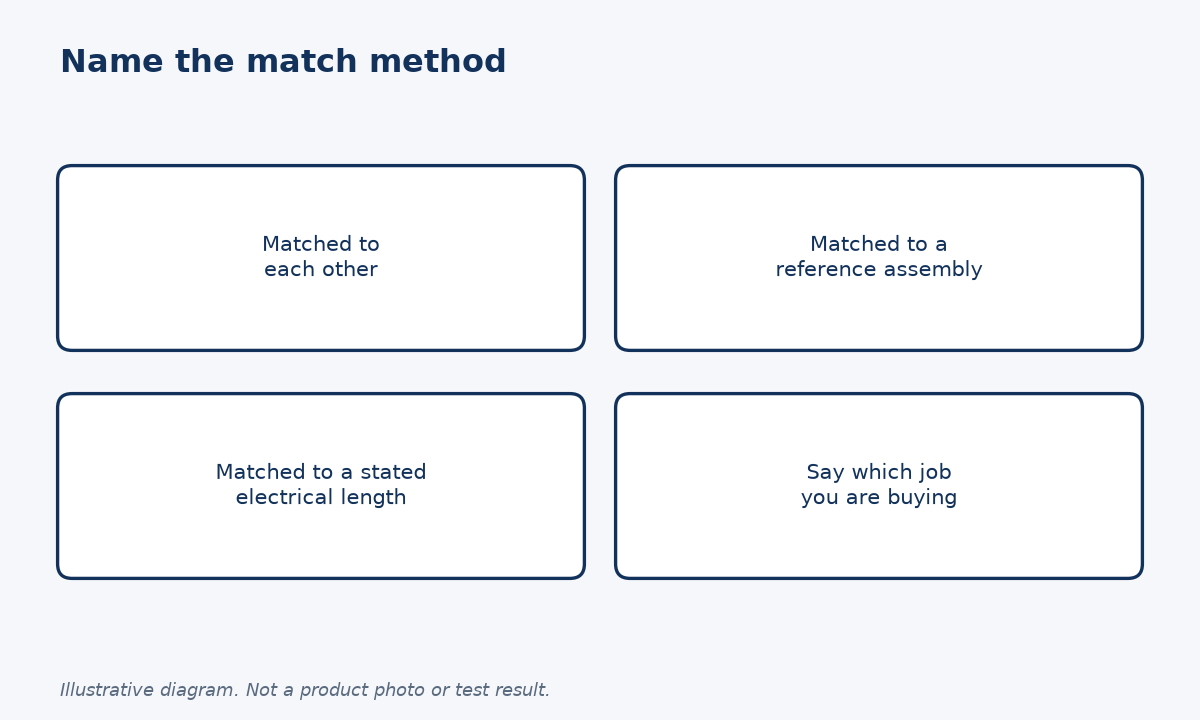
State whether the set is matched to each other, to a reference assembly, or to a stated electrical length at a stated frequency. Those are different jobs, and a quote that omits the method is not comparable to one that includes it.
Three different jobs, one easily omitted line
I ask buyers to close one method question before we talk about how tight the window is. Matched to each other means the cables in the set are compared with one another at the stated frequency, and the difference must stay inside the window. Matched to a reference means each cable is compared with a standard assembly you or the supplier keep. Matched to a stated electrical length means each cable must fall within a window around a delay or phase length that you write down, whether or not another cable in the order is present.
Those three outcomes are not interchangeable. A pair that tracks itself can still sit away from a delay you later need to match in the field. If the installed bends or the temperature will not be the same as the test layout, say so; the match you accept in a standard coil may not be the match you have after installation.
NASA-STD-8739.4A is useful here not because it defines a commercial match method, but because it puts the electrical requirements on the engineering documentation. Section 13.8.8 says coaxial cables shall pass electrical requirements such as VSWR, insertion loss and other performance tests specified on that documentation. Section 18.2.3 adds that coaxial cable assemblies shall be given insertion loss, VSWR and related tests as specified there. The phase window and the match method belong on the same requirement list.
If you already have a reference assembly or a delay figure, send it with the RFQ. If you only need the cables in this order to agree with one another, say that plainly. Either way, a phase matched cable assembly supplier can then quote one job instead of three.
What other electrical and mechanical details belong beside the phase window?
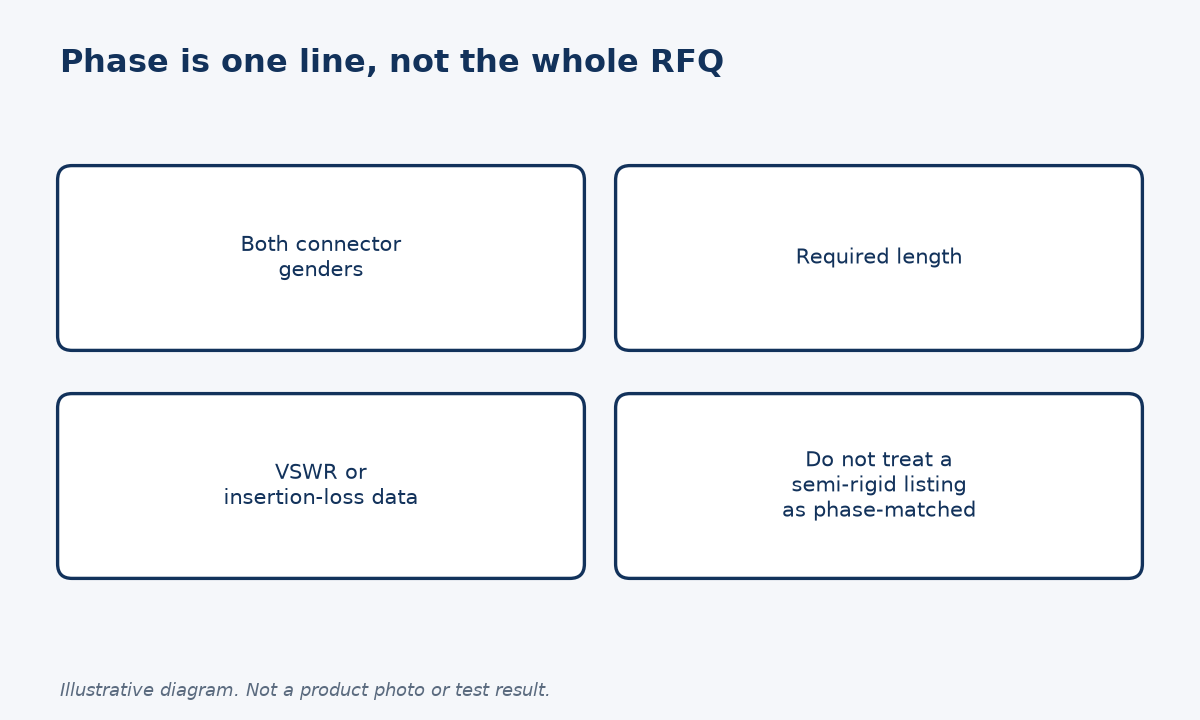
A tight phase window does not replace connector genders, length, impedance or the VSWR and insertion-loss data you will use to accept the set.
Beside the phase window, name both connector types and genders, the length, 50 Ω if that is your system, the frequency band, and the VSWR or insertion-loss limits you need. Ask for the data that will travel with the set.
Phase is one line, not the whole assembly
The catalog example above is 1.85mm male to 1.85mm male. That gender pair will not mate to two female 1.85mm ports without adapters, and an extra junction is a new variable in a matched set. Write both faces. Write the length you actually need; the listed P/N is RL-1.85-405-1.85-1000, but I treat the required length as an RFQ line rather than inferring it from the suffix.
The same product page lists 50 Ω, DC to 67 GHz and a VSWR attribute of 1.45. If you need a different VSWR or an insertion-loss limit, write it. NASA 13.8.8 and 18.2.3 treat VSWR and insertion loss as tests specified on the engineering documentation; they are complementary to the phase window, not implied by it. NASA 17.3.1 also asks that coaxial mating torque be defined in that documentation, which is worth repeating in an incoming-inspection note.
The phase-matched cable assemblies category currently contains the explicitly named phase-matched 1.85mm assembly and a 1.85mm male-to-male semi-rigid assembly that is not named phase-matched. I do not treat the semi-rigid listing as a phase-matched set. If you need phase matching, order from the named listing or state the window and method in the RFQ.
This article is about the phase-match window, the match method and electrical length. It is not a general custom-cable checklist; that work is in our custom RF cable assembly quote request checklist. It is also not a guide to comparing two 2.92mm, 40 GHz quotations; that comparison is covered separately. Use those pages for the surrounding RFQ lines, and keep the phase decisions here.
| Catalog example | P/N | Listed band | What you still must write |
|---|---|---|---|
| 1.85mm male to male, phase matched | RL-1.85-405-1.85-1000 | DC to 67 GHz | Phase window, match method, length, VSWR or insertion-loss data |
If the faces, length or window differ from that example, send the set of requirements rather than substituting a semi-rigid listing.
How do you turn those decisions into a comparable quote request?
Once the window, the method and the mechanical faces are written down, the RFQ can be compared from one supplier to the next.
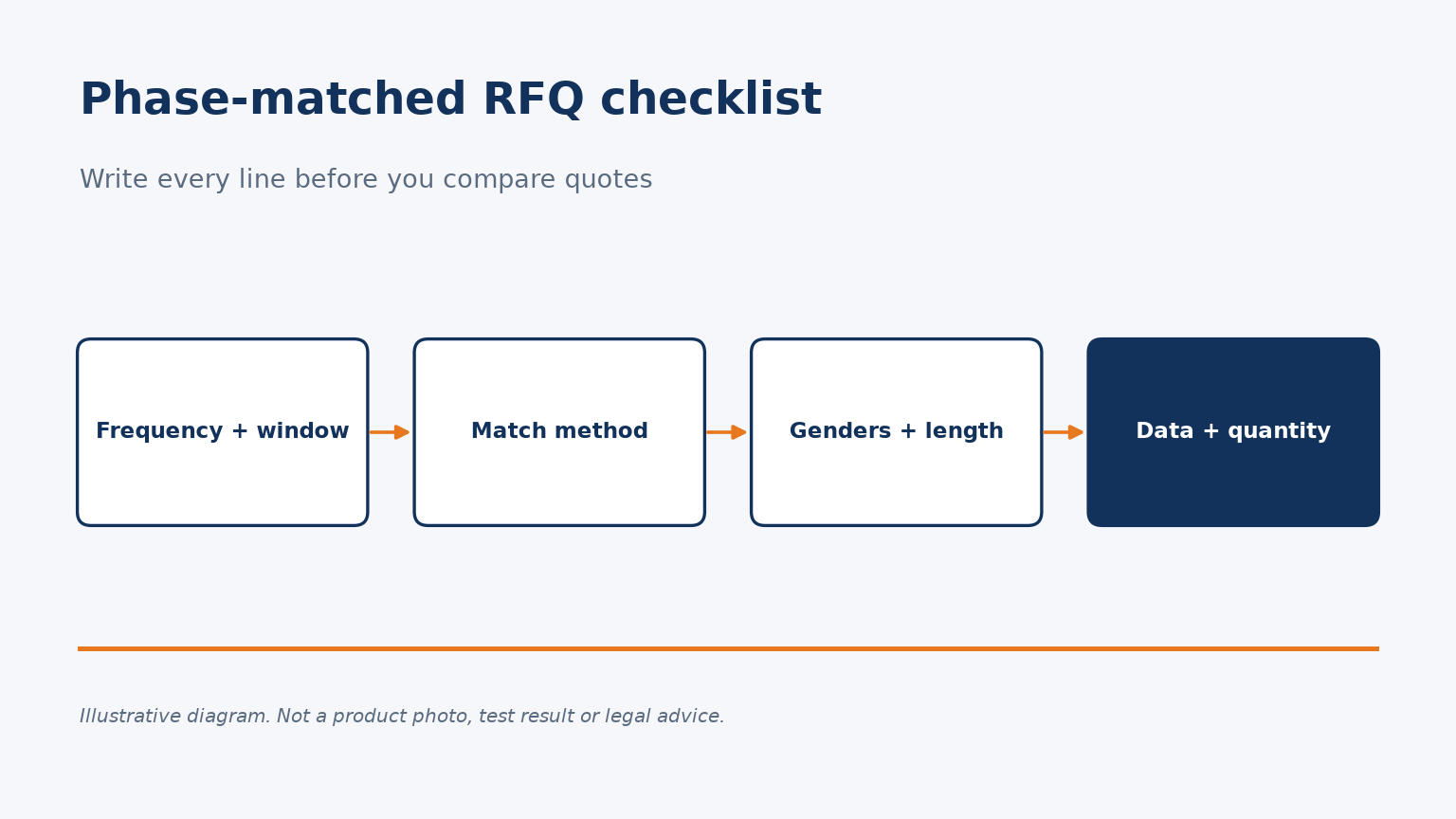
A comparable RFQ lists frequency, phase window, match method, both connector genders, length, quantity and the electrical data you want recorded. Send that list with the application, and our engineers will reply with a recommendation.
A short RFQ list for a phase-matched set
I use the list below when a buyer wants a phase matched cable assembly quotation that another engineer can read without guessing. Frequency and window travel together. The match method tells us whether we are comparing the cables in the set, a reference, or a stated electrical length. The mechanical lines stop a male-to-male example being quoted into a female port.
| RFQ line | What to state |
|---|---|
| Frequency and window | Band, the frequency at which the match is judged, and the phase window in degrees |
| Match method | To each other, to a reference, or to a stated electrical length |
| Interfaces | Connector series and gender on each end |
| Length and quantity | Required length, how many assemblies or pairs |
| Electrical data | 50 Ω if applicable, VSWR or insertion-loss limits, what plots to record |
| Use and handling | Application, temperature, and any installed-bend or torque note |
NASA-STD-8739.4A is the right reminder that those electrical tests are specified on the documentation, not assumed. For a broader custom-cable list, start from the custom RF cable assembly quote request checklist. If you are instead comparing two 2.92mm, 40 GHz quotations, use the quotation comparison article.
When the list is ready, request a quote and include frequency range, connector types and genders, quantity, the application, the phase window and the match method. You can start from the 1.85mm male-to-male phase-matched catalog page and tell us what must change. Our engineers will reply with a part recommendation; please confirm the window and the faces before you place the order.
Frequently asked questions
Does the catalog 67 GHz part already include a phase-match window? No published degree tolerance is stated on the 1.85mm male-to-male phase-matched listing. Put the window you need, and the frequency at which it is judged, in the RFQ.
Is a phase-matched set the same as a semi-rigid 67 GHz assembly? No. The phase-matched category also contains a 1.85mm male-to-male semi-rigid assembly that is not named phase-matched. Order from the explicitly named phase-matched listing, or state the phase requirement in the RFQ.
Should I match cables to each other or to a stated electrical length? Those are different jobs. Say whether the set is matched among the cables in the order, to a reference assembly, or to a stated electrical length at a stated frequency.
What else belongs in a phase matched cable assembly RFQ? Name both connector types and genders, the length, quantity, the application, and the VSWR or insertion-loss data you want recorded. A general custom-cable checklist is a starting point, but it does not replace the phase lines.
Conclusion
Write the frequency, the phase window and the match method; then a phase matched cable assembly quote can be compared.
STAY IN FOR MORE NEWS
Subscribe to our free newsletter.
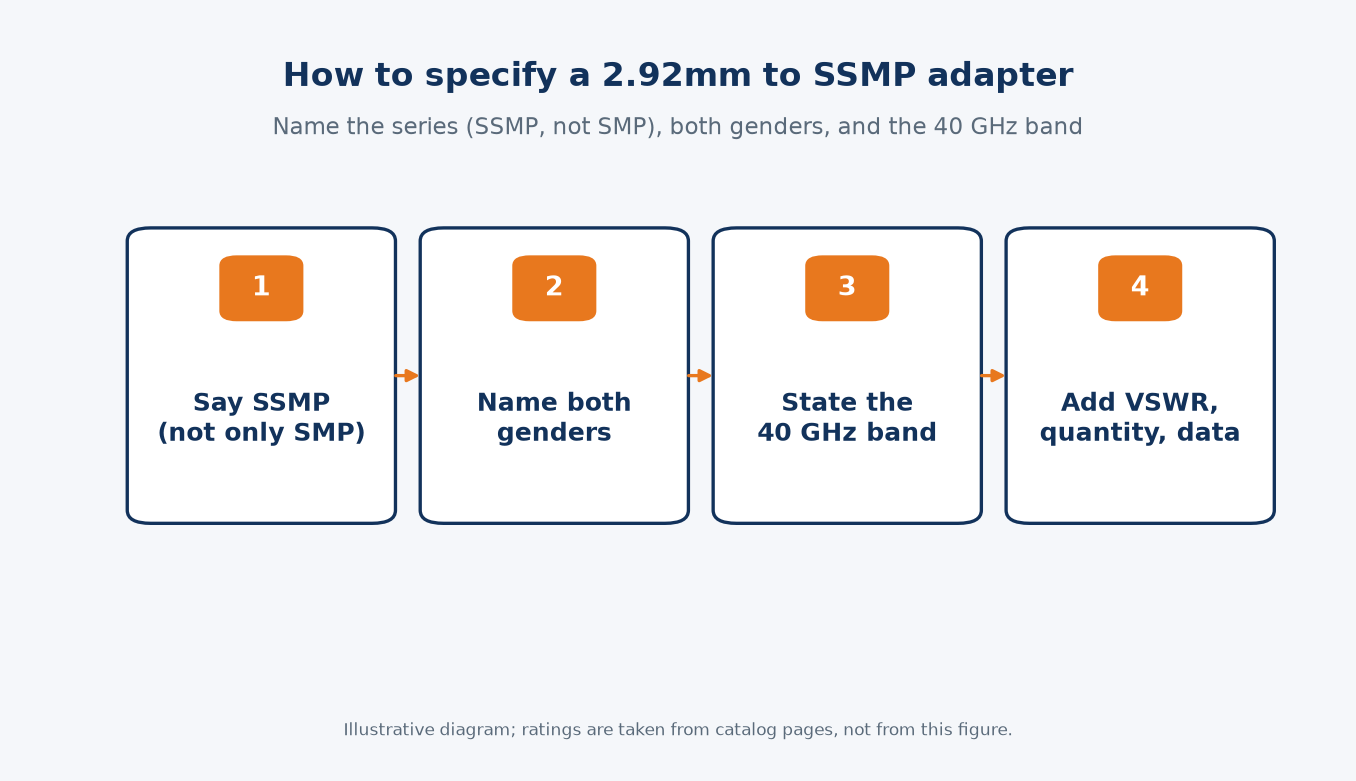
Specify a 2.92mm to SSMP adapter by both genders, 40 GHz band, and whether you need SSMP or SMP. See four catalog gender pairs and a short RFQ checklist.
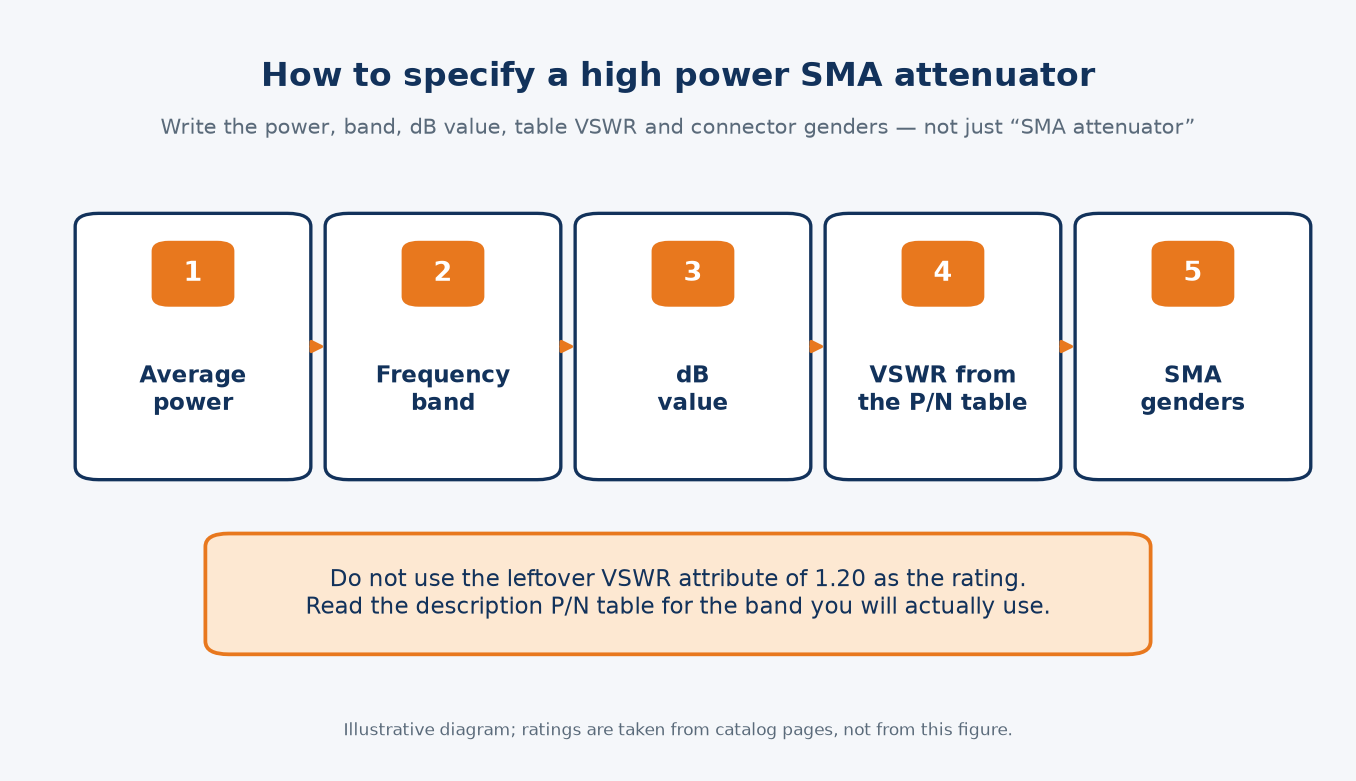
Specify a high power SMA attenuator by average power, band, dB value, VSWR and gender. See catalog 18 GHz options from 2 W to 50 W and an RFQ list.
A 2.4mm to 2.92mm adapter is limited by the 2.92mm face, so catalog parts are listed DC to 40 GHz. See four gender pairs and a short RFQ checklist.
Ask for frequency points, insertion and return loss, and whether you need a factory plot or a lab calibration with your RF attenuator order.
