
by Angela
Share
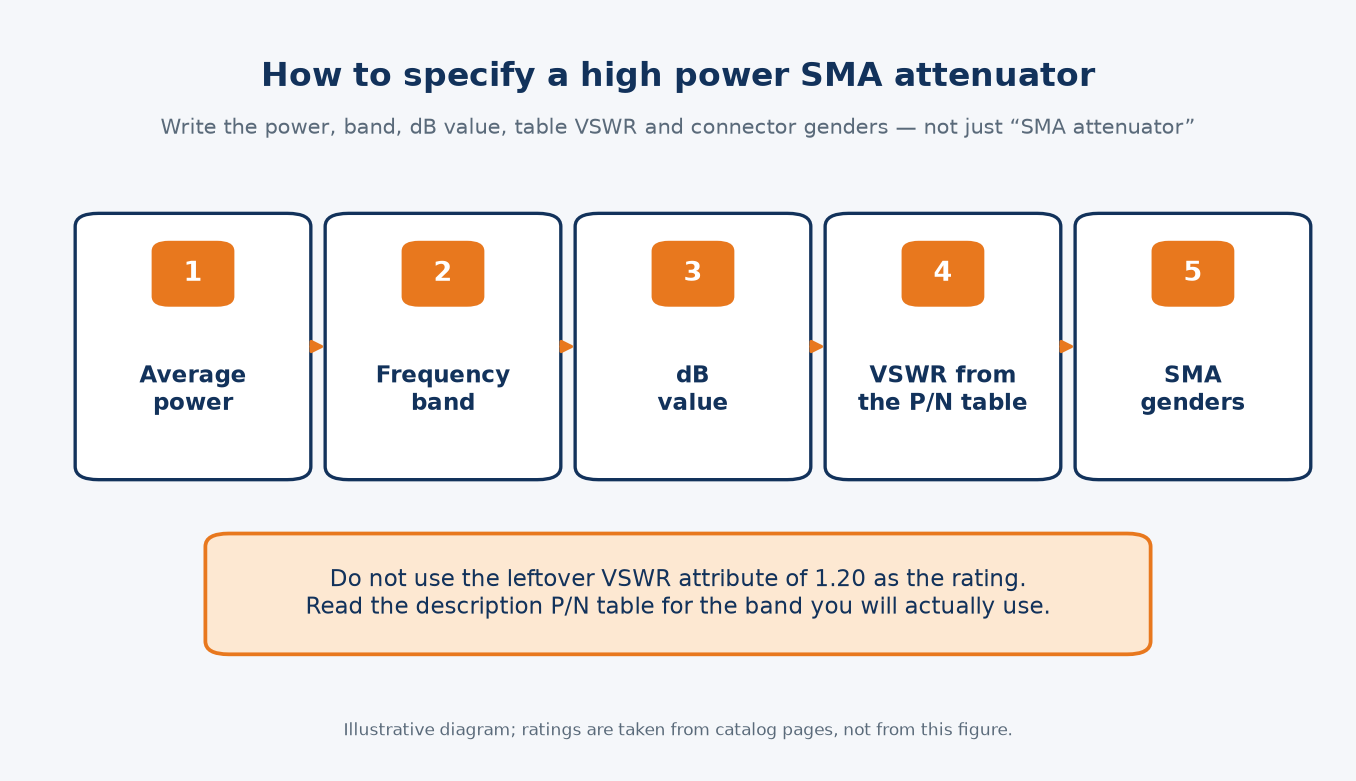
Ordering a high power SMA attenuator without a wattage, a band and a dB value is how a 2 W and a 50 W quote land on the same RFQ.
Specify a high power SMA attenuator by average power, frequency band, dB value, a VSWR limit taken from the description P/N table, and both SMA genders. Do not use the leftover VSWR attribute of 1.20 as the 18 GHz rating.
Below I walk through power options, the 20 W table, dB values and a short RFQ; or start from the SMA fixed attenuator rated to 20 watts up to 18 GHz and tell us what must change.
What does “high power” mean on an SMA attenuator?
High power is not a single catalog size. It is an average-power rating that has to be named, together with the band.
On this site, SMA fixed attenuators are listed at several average-power levels up to 18 GHz, including 10 W, 20 W, 25 W, 30 W and 50 W. Start with the watts your system will apply, then confirm that page’s frequency table.
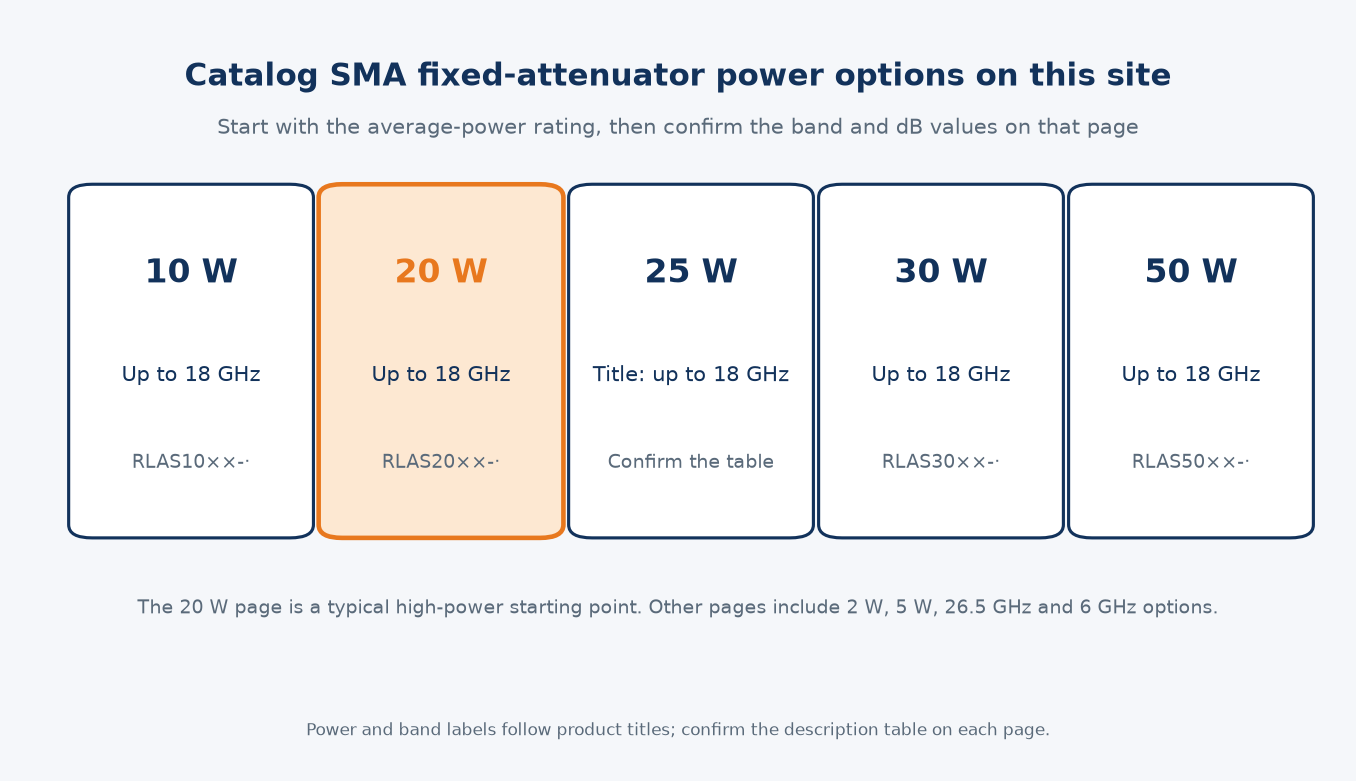
Name the average power, then open that page
A high power SMA attenuator RFQ that only says “high power” is incomplete. Average power is a thermal rating: the continuous power the part is listed to handle. If your application is pulsed, say so in the RFQ, including pulse width and duty cycle if you have them. I will not invent a peak-power figure that is not on the product page.
The 18 GHz SMA family on this site includes these catalog pages, each with its own description table:
| Listed average power | Title band | Product page |
|---|---|---|
| 10 W | Up to 18 GHz | SMA 10 W attenuator |
| 20 W | Up to 18 GHz | SMA 20 W attenuator |
| 25 W | Up to 18 GHz | SMA 25 W attenuator |
| 30 W | Up to 18 GHz | SMA 30 W attenuator |
| 50 W | Up to 18 GHz | SMA 50 W attenuator |
Lower-power SMA pages are also in the catalog, including a 2 W part listed up to 18 GHz. A 5 W title exists as well; its published P/N table currently lists 2 W, so I will not treat that table as a 5 W rating. Confirm the 5 W page in the RFQ if that is the part you meant. There is also an SMA page listed to 26.5 GHz in 20 W and 50 W versions, and a 50 W part listed to 6 GHz. Those are different bands, not substitutes for an 18 GHz high power SMA attenuator unless your system actually stops at 6 GHz or needs 26.5 GHz.
One data caution on the 25 W page: the title and technical-data line say up to 18 GHz, but the published P/N table on that page shows rows only through DC–12.4 GHz. If you need 25 W at 18 GHz, ask us to confirm the rating rather than assuming the missing table row.
This article is about SMA hardware. If the connectors are Type N, use our high power N type attenuator notes instead of forcing an SMA quote onto an N path. For the difference between fixed, variable and step parts, see fixed vs variable and step RF attenuators.
Why shouldn’t you use the leftover VSWR attribute as the rating?
Several SMA attenuator pages carry a generic VSWR attribute of 1.20 that does not match the description table.
On the 20 W page, the description P/N table lists VSWR of 1.2, 1.25, 1.35 and 1.45 for the 4, 6, 12.4 and 18 GHz bands. Use the table for your band. The leftover 1.20 attribute is not the 18 GHz rating.
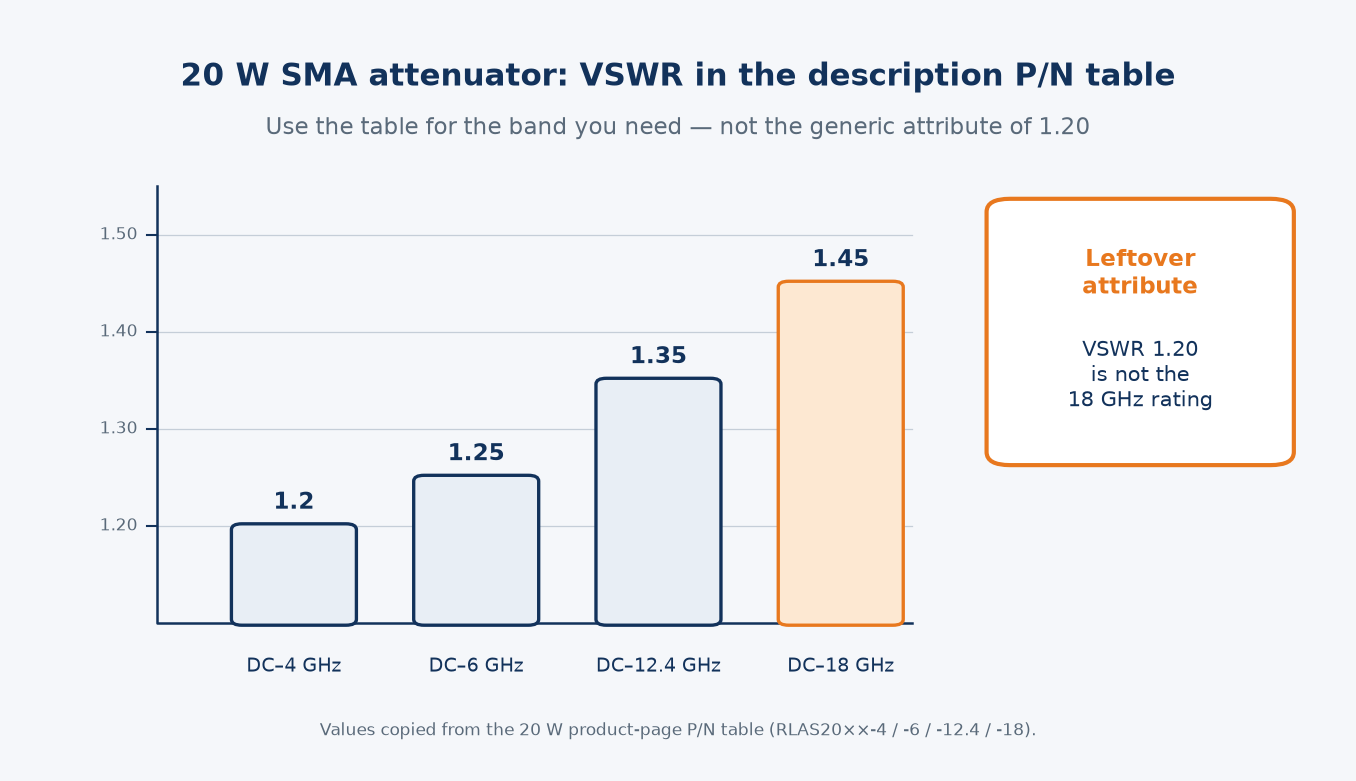
The description table is the rating to quote
When a WooCommerce attribute and a description table disagree, I quote the table and the title, and I do not treat the leftover attribute as the published performance. That is the case on the 20 W SMA page. The attribute says VSWR 1.20. The P/N table in the description says something more useful, and more honest about frequency:
| P/N pattern | Frequency range | Power | Connector (as listed) | Attenuations (dB) | VSWR |
|---|---|---|---|---|---|
| RLAS20☓☓-4 | DC–4 GHz | 20 W | SMA/N | 1–9 / 10 / 20 / 30 / 40 | 1.2 |
| RLAS20☓☓-6 | DC–6 GHz | 20 W | SMA/N | 1–9 / 10 / 20 / 30 / 40 | 1.25 |
| RLAS20☓☓-12.4 | DC–12.4 GHz | 20 W | SMA/N | 1–9 / 10 / 20 / 30 / 40 | 1.35 |
| RLAS20☓☓-18 | DC–18 GHz | 20 W | SMA/N | 1–9 / 10 / 20 / 30 / 40 | 1.45 |
The same pattern — VSWR rising in the higher bands — appears on the 10 W, 30 W and 50 W 18 GHz pages, with their own table values. I copied the 20 W rows above from that page; I did not invent a derating curve beyond what is printed.
This matters because attenuation is a power ratio, and mismatch changes what the load actually receives. NBS Monograph 97 is still a clear government review of microwave attenuation measurement and of mismatch and connector errors. If you care about the number you will receive, put a VSWR or return-loss limit on the RFQ for the band you will use, and say whether you want a typical plot or data with the parts. Our notes on RF attenuator calibration and how to test attenuator accuracy cover the measurement side; this page is about getting the catalog specification right first.
The 20 W table also lists the connector column as SMA/N, because that power family is documented for both series. This article is the SMA path. If you need N connectors, say so and we will quote the N family instead.
Which dB values and SMA genders should go in the RFQ?
Power and band still leave the attenuation value and the two connector faces unnamed.
Write the exact dB value you need, taken from the description table where possible, and name SMA male or female on each port. The 20 W table lists 1–9, 10, 20, 30 and 40 dB; confirm 50 dB or 60 dB if you need them.
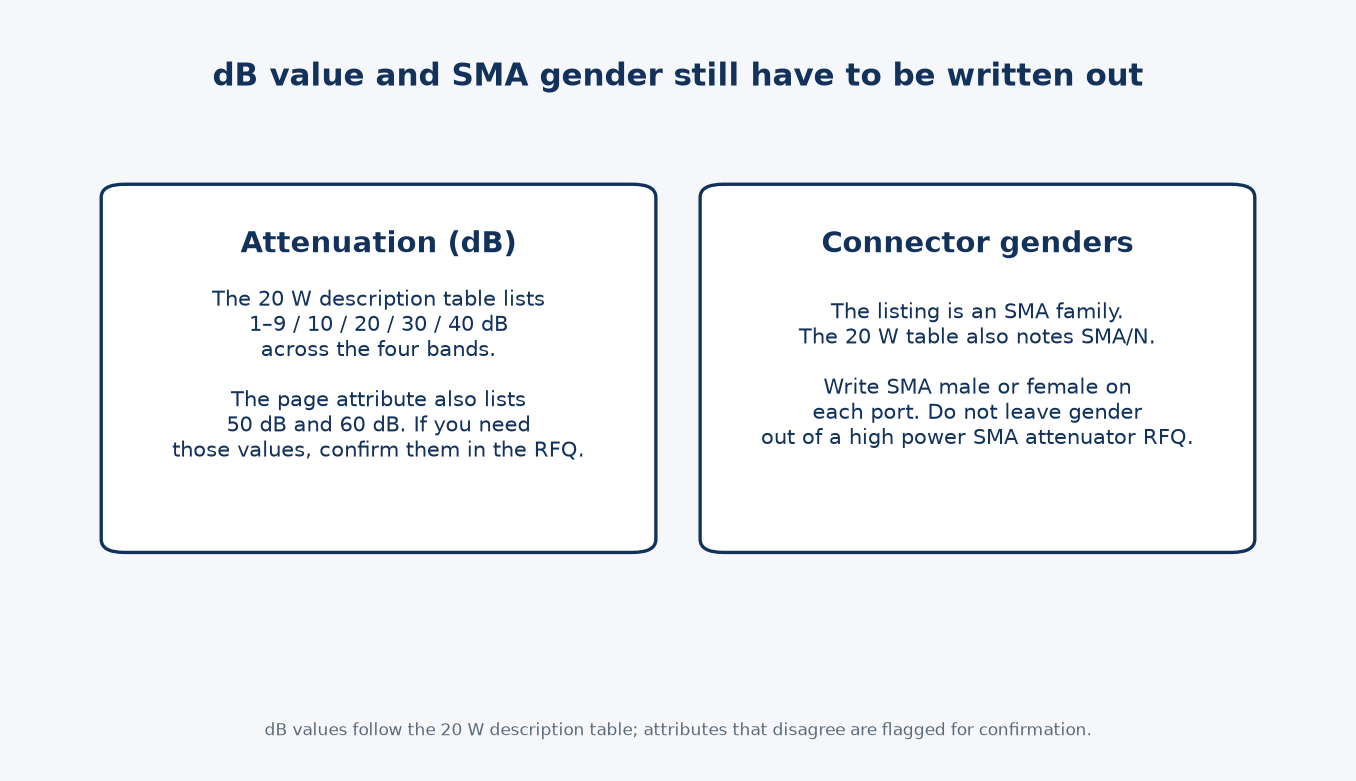
The family range is not an orderable part
The 20 W description table lists attenuations of 1–9, 10, 20, 30 and 40 dB in each of the four bands. That is the set I will treat as published for that family. The same page’s WooCommerce attribute also lists 50 dB and 60 dB. Those extra values are not in the printed table, so if you need 50 dB or 60 dB at 20 W, put the value in the RFQ and ask us to confirm it. Other power pages have their own tables: the 10 W table also stops at 40 dB, while the 30 W and 50 W 18 GHz tables include 50 dB. Do not copy a dB list from one power family onto another.
Gender is the other missing line. The catalog pages describe an SMA fixed attenuator, but they do not freeze male or female on each port in the title. Write both faces (“SMA male input, SMA female output”, or the pair you actually have). A high power SMA attenuator with the wrong gender will not mate, and a gender adapter in front of it is another junction, not a free correction. NASA-STD-8739.4A reminds assemblers to use the mating torque from the engineering documentation and to turn only the coupling nut, which is worth repeating in an incoming-inspection note when these parts will be installed by hand.
NIST work on coaxial connector repeatability shows that connector mating is a leading source of random error in precision measurements. An extra, loosely specified adapter in front of a high-power attenuator is not free, electrically or thermally.
All of the 18 GHz SMA pages I used also list 50 Ω, a temperature range of −55 °C to +85 °C, a durability of at least 500 matings, a passivated stainless-steel body (Su303), a gold-plated beryllium-copper inner contact and a PTFE insulator. Those common lines are useful, but they do not replace the power, band, dB and gender you still have to write down.
What should a high power SMA attenuator RFQ include?
A complete request makes a 10 W quote and a 50 W quote comparable, and it stops a leftover 1.20 VSWR from being treated as the rating.
State average power, the frequency band, the exact dB value, a VSWR or return-loss limit from the P/N table, both SMA genders, quantity, and any plots or pulse data the application requires.
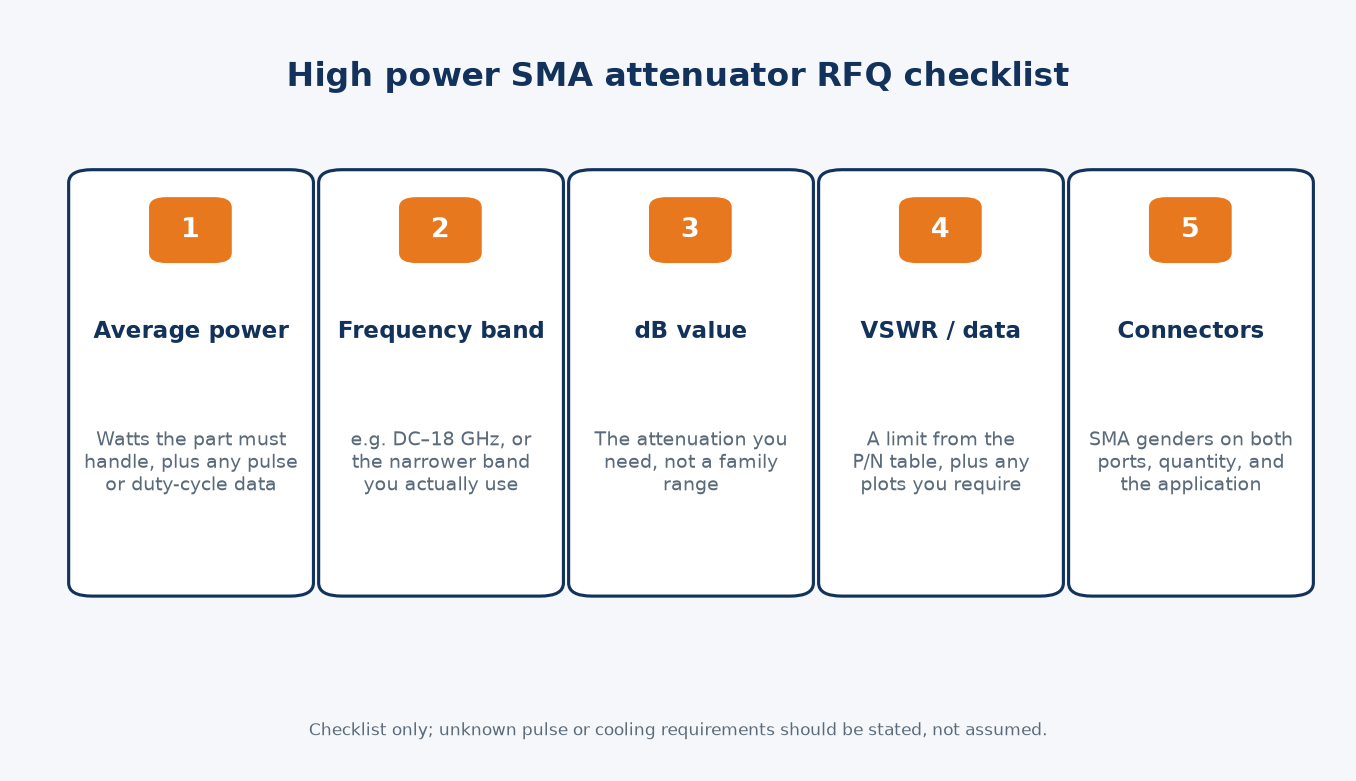
A checklist you can paste into the RFQ
I group the request into power, electrical, interface and records. Power is the average watts, plus pulse width and duty cycle if the signal is not CW. Electrical is 50 Ω, the band, the dB value, and the VSWR or return-loss limit across that band, taken from the description table rather than from a leftover attribute. Interface is SMA male or female on each port. Records are whether a typical plot is enough or you want data with each unit.
| RFQ line | What to state |
|---|---|
| Power | Average watts; pulse and duty cycle if not CW |
| Band and dB | Frequency range and the exact attenuation |
| Match | VSWR or return loss from the P/N table for that band |
| Connectors | SMA gender on each port |
| Quantity and data | How many, and what plots or certs |
When the list is ready, request a quote and include frequency range, connector types and genders, quantity, the dB value, the average power, and the application. You can start from the 20 W SMA page and tell us what must change. Our engineers will reply with a part recommendation; please confirm the power, band, dB value and genders before you place the order.
Frequently asked questions
What should I specify for a high power SMA attenuator? Average power, frequency band, dB value, a VSWR limit from the description P/N table, and both SMA genders. Add pulse data if the signal is not continuous.
Why is the VSWR attribute 1.20 if the table shows 1.45 at 18 GHz? On several SMA pages the 1.20 figure is a leftover attribute. Quote the P/N table for the band you will use. On the 20 W page, the 18 GHz row is 1.45.
Is a 20 W SMA attenuator the same as a 20 W N attenuator? No. The connector series is part of the specification. Use this article for SMA, and the high power N type attenuator article when the ports are Type N.
Do the 20 W dB options include 50 dB and 60 dB? The description table lists 1–9, 10, 20, 30 and 40 dB. The page attribute also lists 50 dB and 60 dB. If you need those higher values, confirm them in the RFQ.
Conclusion
Name the watts, the band, the dB value and both genders, and read the P/N table when you specify a high power SMA attenuator.
STAY IN FOR MORE NEWS
Subscribe to our free newsletter.
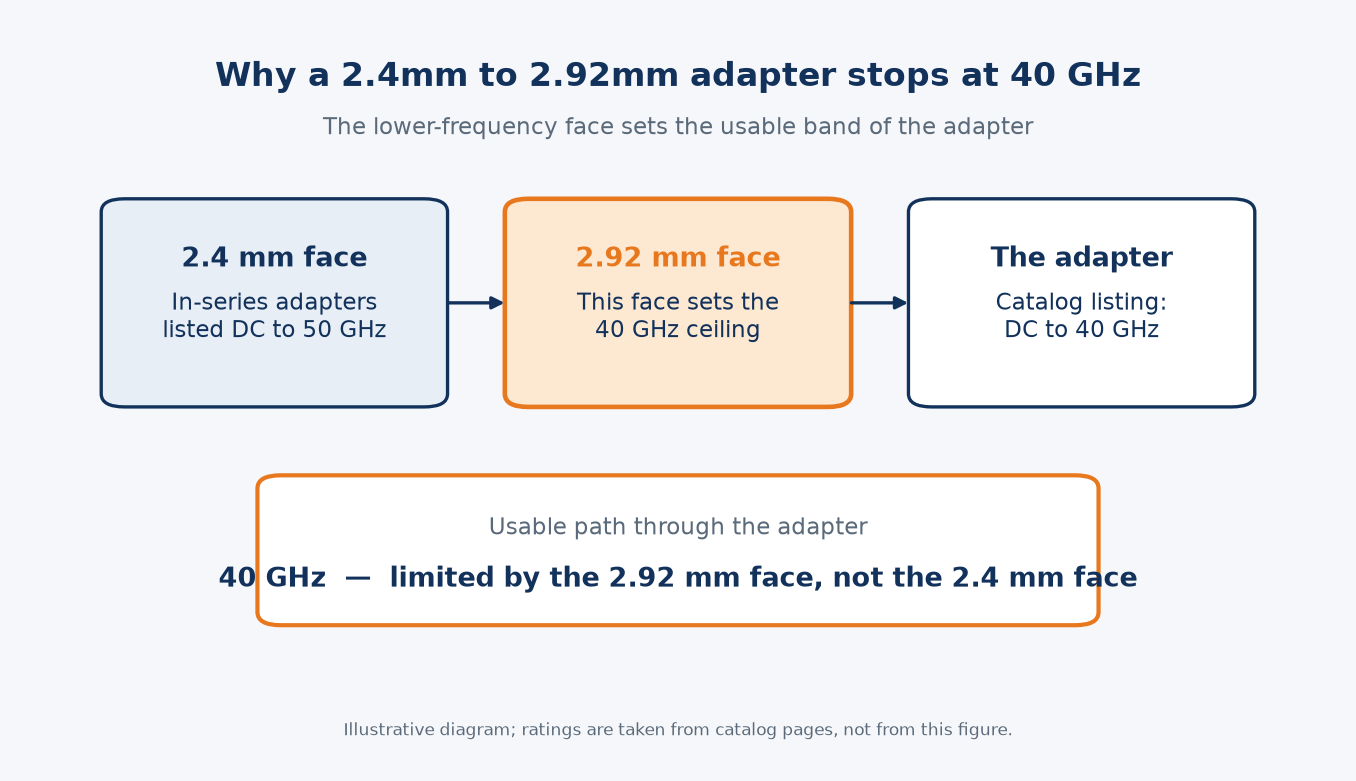
A 2.4mm to 2.92mm adapter is limited by the 2.92mm face, so catalog parts are listed DC to 40 GHz. See four gender pairs and a short RFQ checklist.
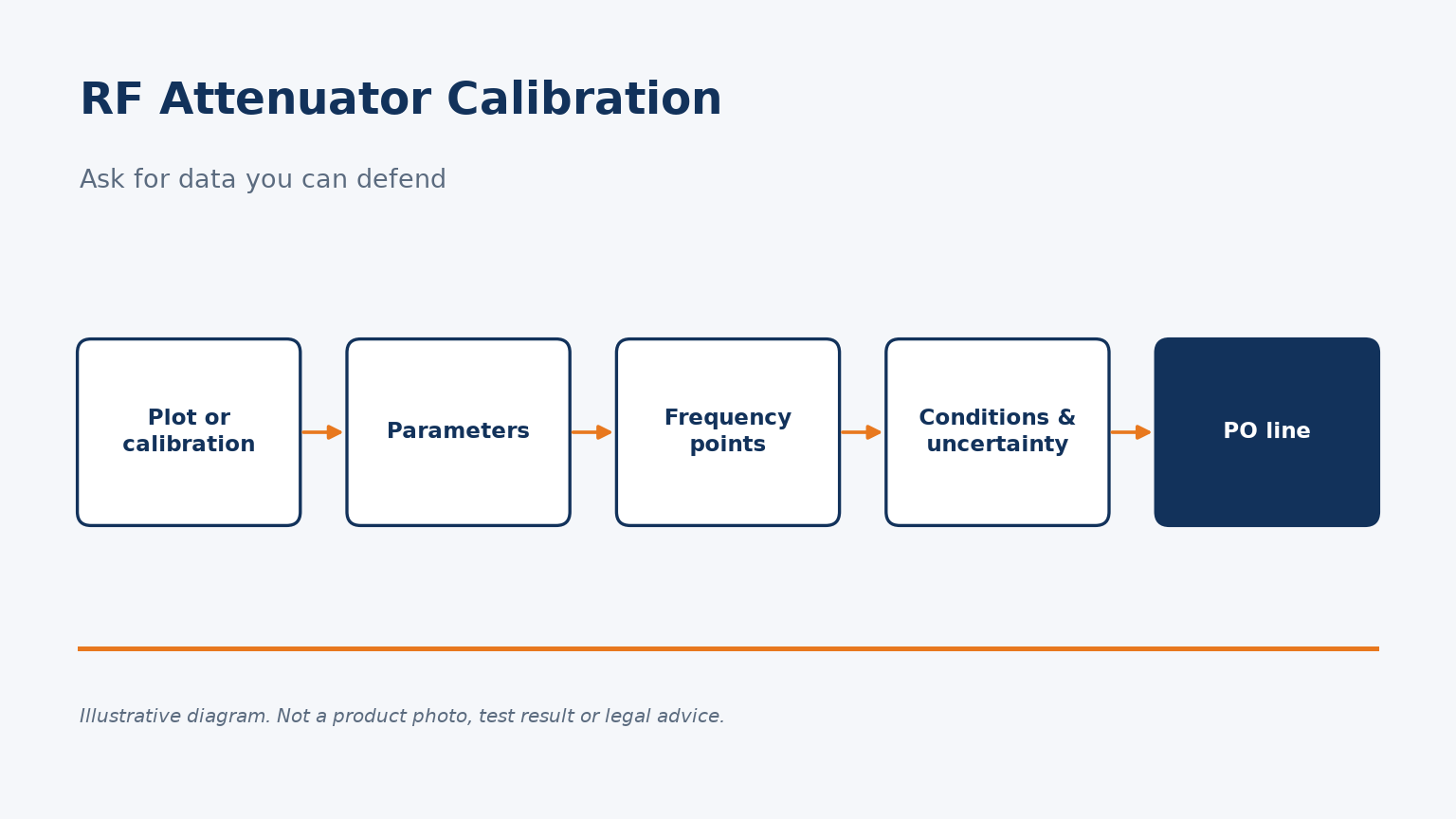
Ask for frequency points, insertion and return loss, and whether you need a factory plot or a lab calibration with your RF attenuator order.
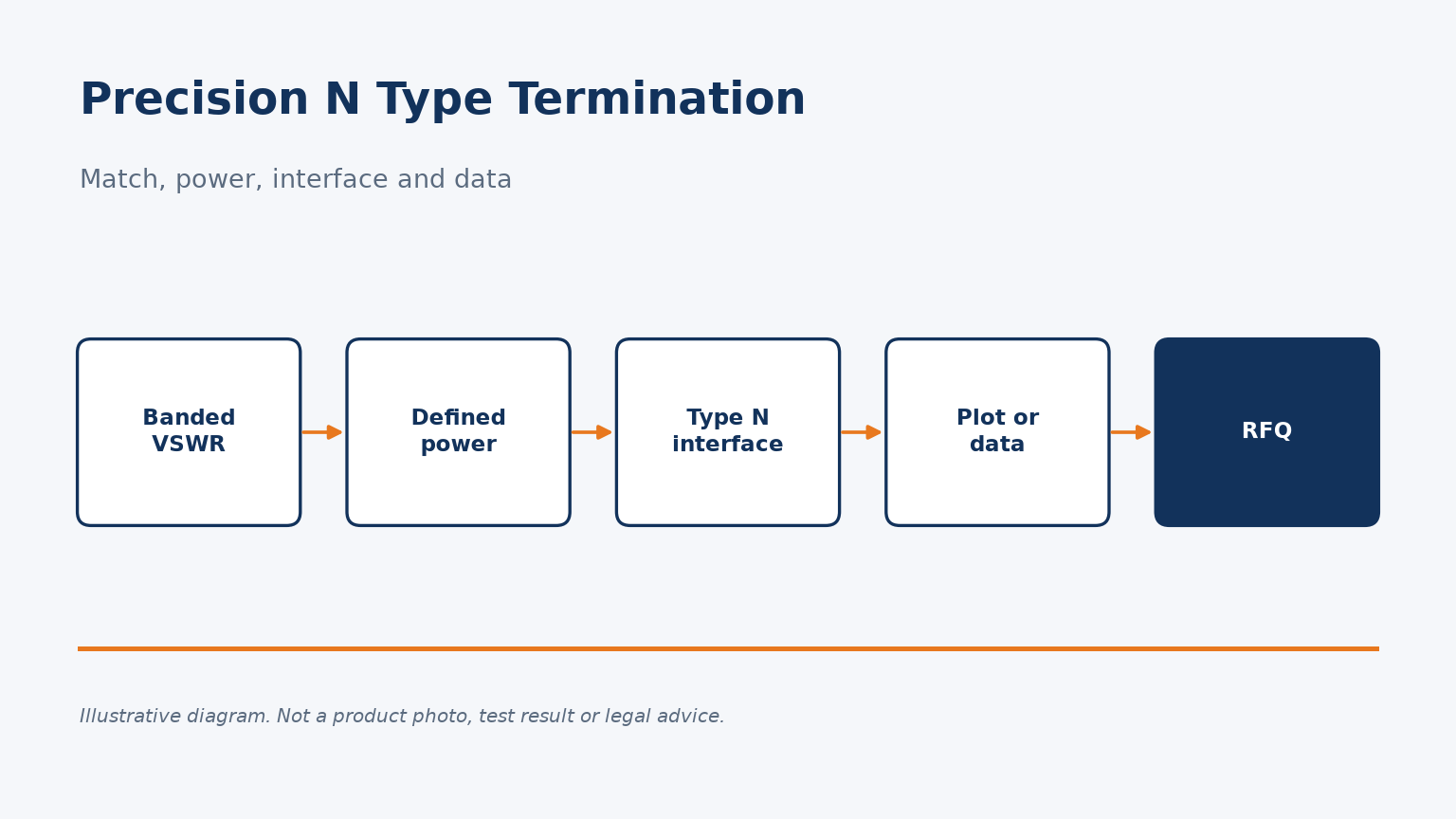
A precision N type termination is defined by banded VSWR, power and data, not a label. See what to request besides a catalog 18 GHz Type N load.
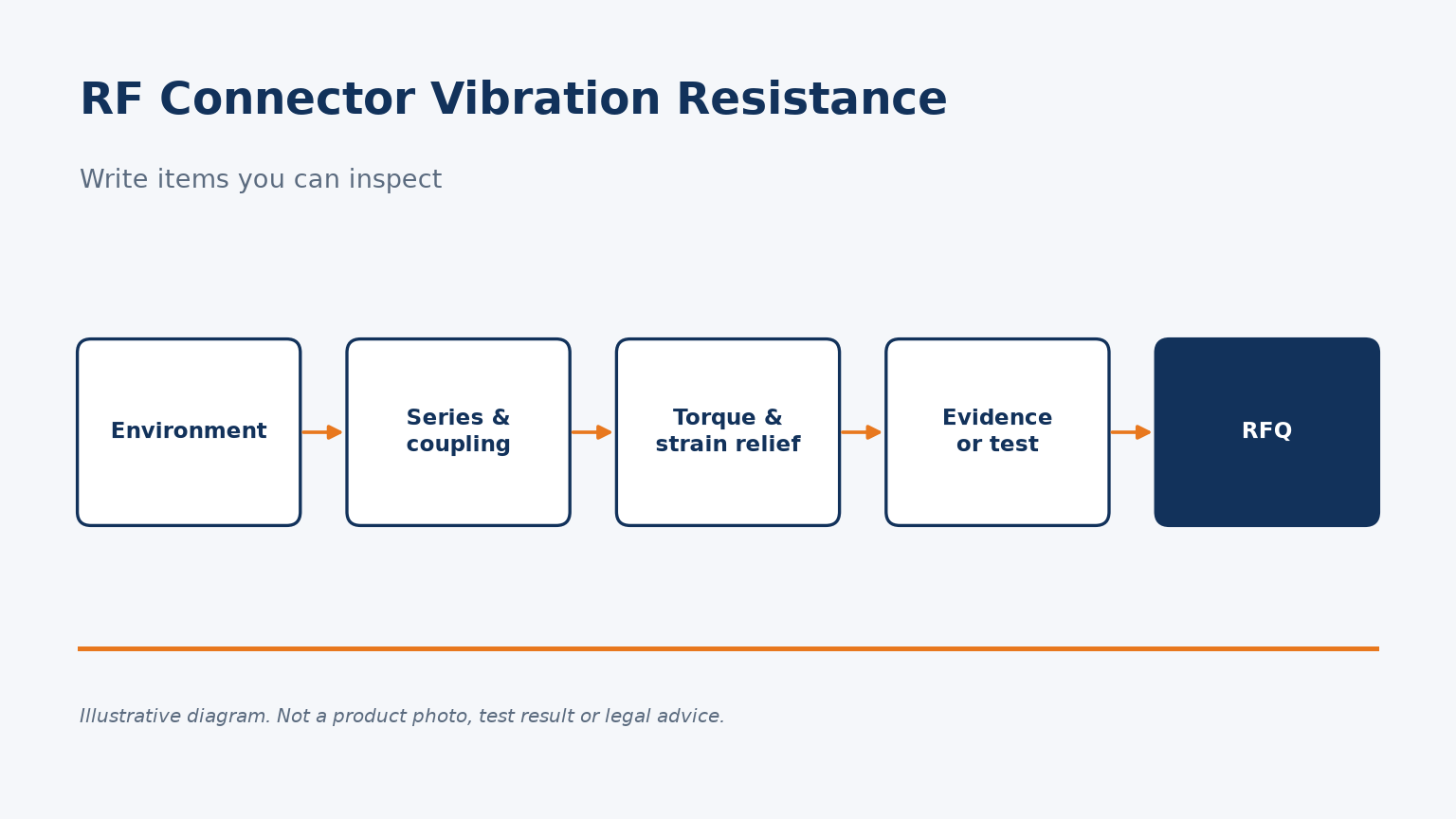
Vibration resistance is not a part number. Specify coupling style, torque, strain relief and the test method in your RF connector or cable RFQ.
