
by Angela
Share
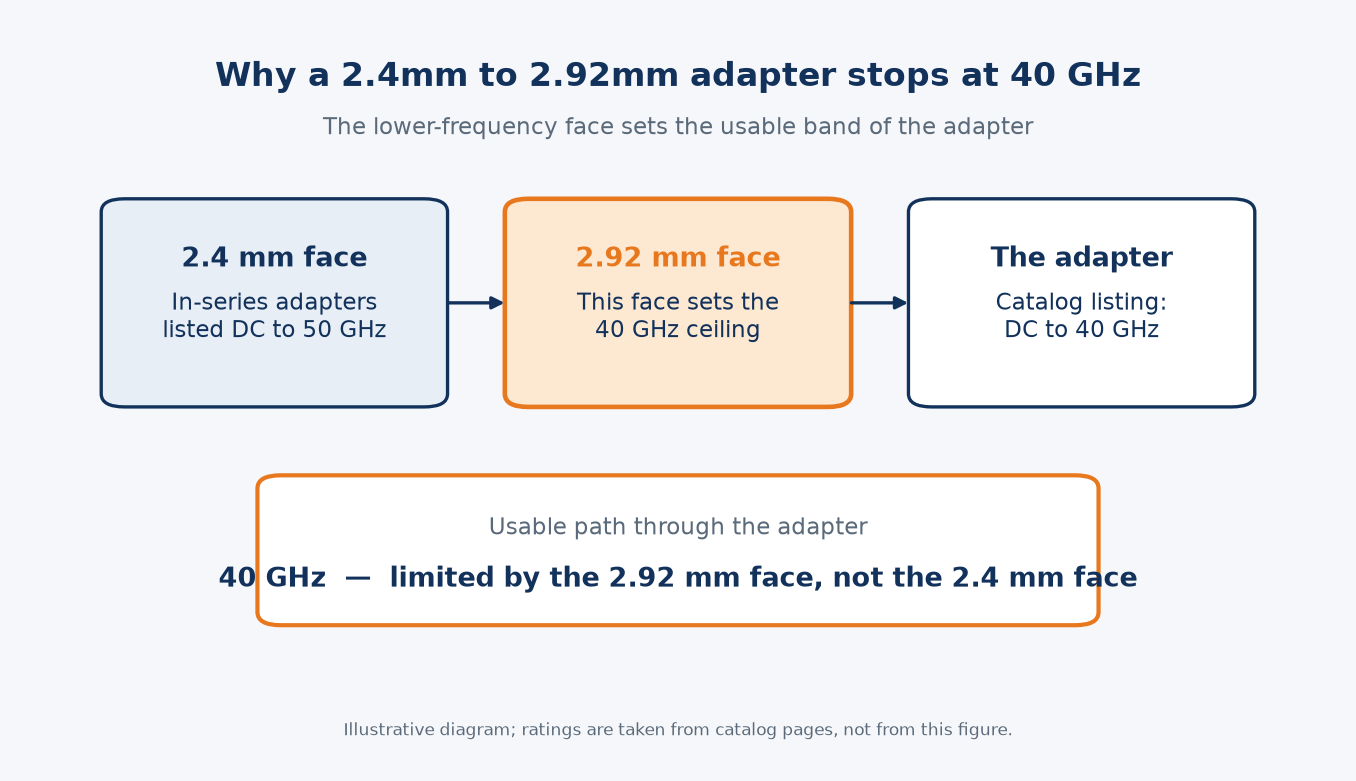
Ordering a 2.4mm to 2.92mm adapter for a 50 GHz bench is how a 40 GHz interface quietly becomes the limit of the path.
A 2.4mm to 2.92mm adapter is limited to 40 GHz by the 2.92 mm face, not the 2.4 mm face. Catalog gender pairs are listed DC to 40 GHz; in-series 2.4 mm adapters are listed DC to 50 GHz. Specify both genders in the RFQ.
Below I compare the two faces, the four catalog genders, and a short RFQ; or start from the 2.4 mm male to 2.92 mm female adapter and tell us which pair you need.
Why does the 2.92 mm face set a 40 GHz ceiling?
The 2.4 mm side of the adapter can look like a 50 GHz promise, until you look at the other face.
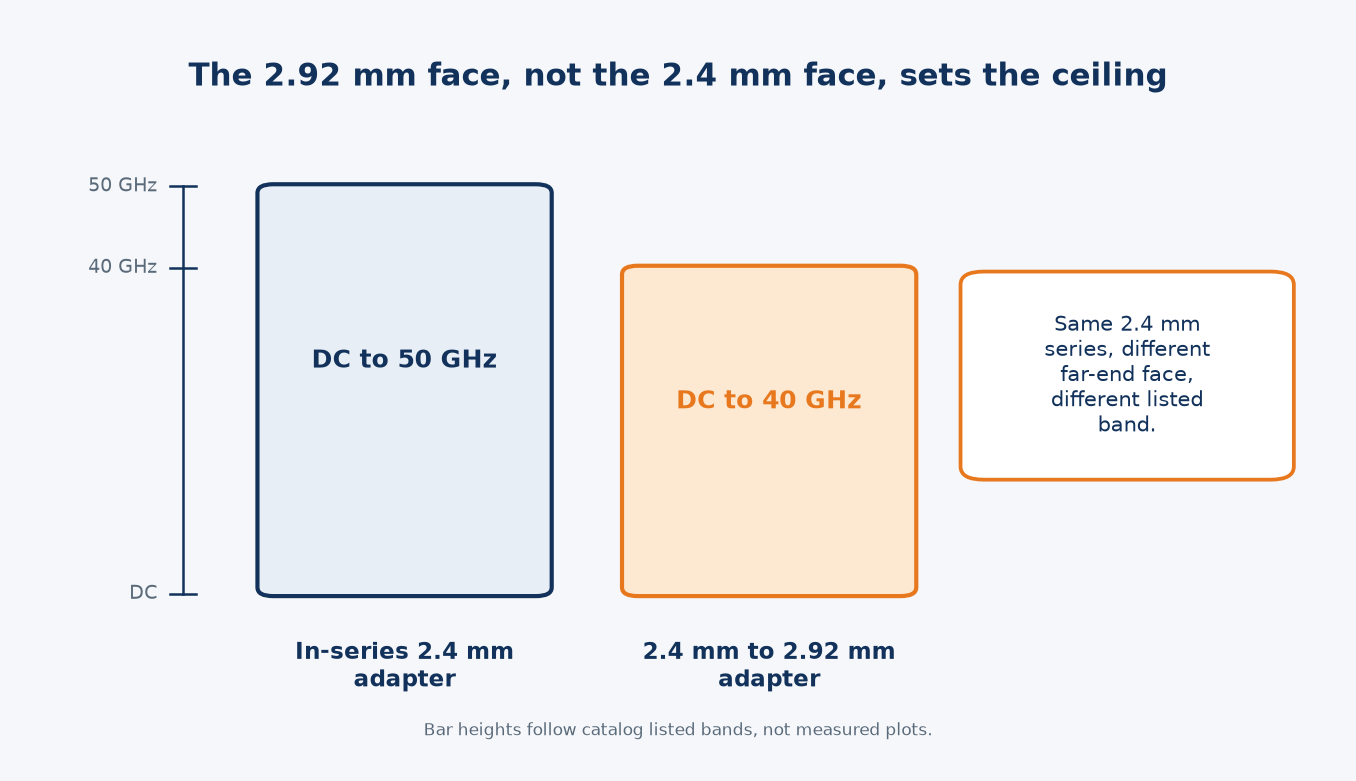
A between-series adapter is only as useful as its lower-frequency interface. On this site, a 2.4mm to 2.92mm adapter is listed DC to 40 GHz, while in-series 2.4 mm adapters are listed DC to 50 GHz.
The lower-frequency interface sets the band
A coaxial adapter cannot raise the rating of the face that runs out of band first. IEC 61169-35 is the sectional standard for the 2.92 series mating face. IEC 61169-40 is the sectional standard for the 2.4 series mating face. Those are two different interfaces, not two names for the same connector.
The public IEC abstracts identify the series and the mating-face work; they do not, on the pages I opened, publish a 40 GHz or 50 GHz limit I can quote. The catalog does. Every 2.4mm to 2.92mm adapter we list is titled and described as DC to 40 GHz, with a VSWR attribute of 1.25. On the same site, in-series 2.4 mm adapters are listed DC to 50 GHz. If the 2.4 mm face were setting the ceiling, the mixed adapter would also be listed to 50 GHz. It is not.
That contrast is the decision I want a buyer to make. NIST has used 2.4 mm coaxial hardware as a national microwave power standard from 50 MHz to 50 GHz, which is consistent with treating 2.4 mm as a 50 GHz-class interface. Joining it to a 2.92 mm port does not extend the 2.92 mm face.
| Adapter family | Example P/N | Listed band | Listed VSWR (attribute) |
|---|---|---|---|
| 2.4 mm male to 2.92 mm female | RL-2.4/2.92-JKG | DC to 40 GHz | 1.25 |
| 2.4 mm male to 2.4 mm male | RL-2.4-JJG | DC to 50 GHz | 1.30 |
| 2.4 mm male to 2.4 mm female | RL-2.4-JKG | DC to 50 GHz | 1.30 |
| 2.4 mm female to 2.4 mm female | RL-2.4-KKG | DC to 50 GHz | 1.30 |
One URL caution: the male-to-male 2.4 mm adapter uses P/N RL-2.4-JJG and a male-to-male title, but its slug still contains the word “female”. Order from the title and the P/N, not from the slug alone. Our RF connector frequency range chart puts these series in a wider family context. If the path must stay at 50 GHz, keep both ends in 2.4 mm. If you truly need to join 2.4 mm to 2.92 mm, accept the 40 GHz listing and specify the gender pair.
Which 2.4mm to 2.92mm adapter gender pairs are in the catalog?
The search phrase names two series, but it does not name the two genders that actually have to mate.
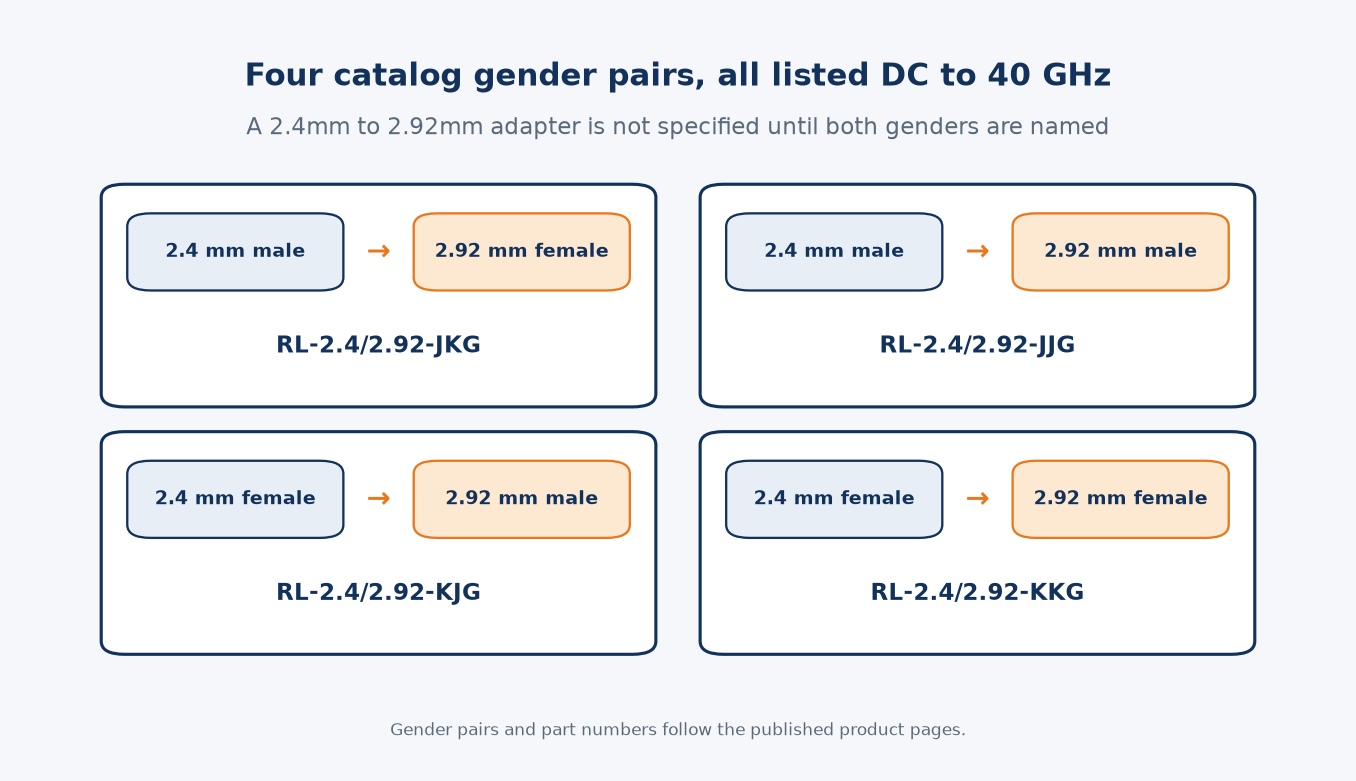
A 2.4mm to 2.92mm adapter is specified by the exact gender pair. We list all four combinations as DC to 40 GHz, 50 Ω, stainless-steel catalog parts with a VSWR attribute of 1.25.
Four combinations, four part numbers
In coaxial hardware, “male” and “female” refer to the contact and the coupling interface, not to the name of the series. A 2.4 mm test port that is female needs a 2.4 mm male adapter face; a 2.92 mm cable that is male needs a 2.92 mm female face. Writing only “2.4 mm to 2.92 mm” leaves four equally plausible parts on the table, and a wrong-gender shipment will not mate. Adding a gender changer later adds another junction.
We publish all four gender combinations as DC to 40 GHz catalog adapters:
| Gender pair | P/N | Product page |
|---|---|---|
| 2.4 mm male to 2.92 mm female | RL-2.4/2.92-JKG | Product 5936 |
| 2.4 mm male to 2.92 mm male | RL-2.4/2.92-JJG | Product 5938 |
| 2.4 mm female to 2.92 mm male | RL-2.4/2.92-KJG | Product 5937 |
| 2.4 mm female to 2.92 mm female | RL-2.4/2.92-KKG | Product 5935 |
All four listings also give a temperature range of −55 °C to +85 °C, a durability of at least 500 matings, a passivated stainless-steel body (Su303), a gold-plated beryllium-copper inner contact and a PEI insulator. The VSWR attribute on each page is 1.25. I would still ask for the VSWR or return-loss limit across your actual band, because a single attribute is not a plot, and because your system may be much narrower than 40 GHz.
The female-to-female page, P/N RL-2.4/2.92-KKG, has a working URL that includes an encoded extra suffix. Confirm the title and the P/N on the page before you order from a copied link. If you already know the two faces, open the matching product page or send the pair to us for a quote.
Are 2.4 mm and 2.92 mm connectors interchangeable without an adapter?
Buyers sometimes treat nearby millimeter sizes as if they shared a mating face. These two series do not.
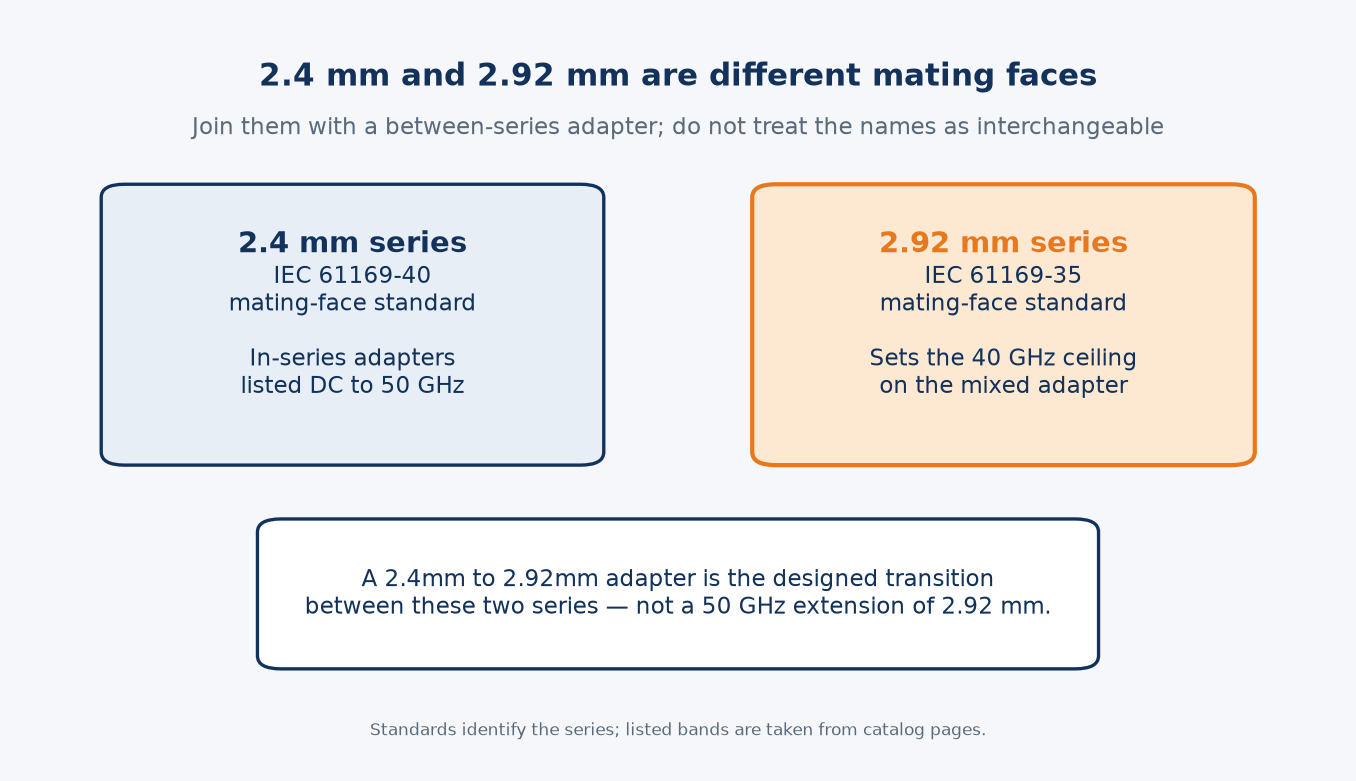
2.4 mm and 2.92 mm are different interfaces, with separate IEC mating-face standards. A 2.4mm to 2.92mm adapter exists because you need a designed between-series transition, not a forced connection or a renamed connector.
Different series, different mating faces
IEC 61169-40 covers the 2.4 series RF connector. IEC 61169-35 covers the 2.92 series. IEEE 287.1-2021 also lists both 2.4 mm and 2.92 mm among the precision coaxial connector sizes in its scope. MIL-STD-348 is the interface standard that defines RF connector mating-face dimensions for many series used in this kind of hardware. None of that makes the two faces the same part, and it does not turn a 2.92 mm port into a 50 GHz port.
A related confusion is the mechanically compatible family of SMA, 3.5 mm and 2.92 mm, which we discuss in 2.92 mm vs 3.5 mm vs SMA compatibility. That article is about a different set of interfaces. 2.4 mm is not in that grouping; it has its own series standard and its own in-series adapters. A step from 2.92 mm toward 1.85 mm is a different transition, covered in our note on 2.92 mm to 1.85 mm adapters versus an adapter stack. Coming from Type N is a lower-band problem; see N to 2.92 mm adapters.
The practical rule is simple. If both ends of the path can stay in 2.4 mm, use an in-series 2.4 mm adapter or a 2.4 mm cable and keep the 50 GHz listing. If one end is truly 2.92 mm, use a 2.4mm to 2.92mm adapter, write both genders, and plan the path to 40 GHz. Do not assume that “they look close in size” is a mating specification, and do not stack extra adapters just to avoid naming the correct pair.
If the mechanical job is not a straight in-line adapter — a bulkhead, a panel mount or a right-angle body — say so in the RFQ. The four catalog genders above are straight between-series parts. I will not treat a different body style as a drop-in substitute that is not on the same page.
What should a 2.4mm to 2.92mm adapter RFQ include?
A short, complete request makes four similar quotes comparable and prevents a 50 GHz assumption from slipping through.
State both series, both genders, 50 Ω, the frequency band (catalog parts are DC to 40 GHz), a VSWR or return-loss limit, the body style, quantity, and any test data you want with the parts.
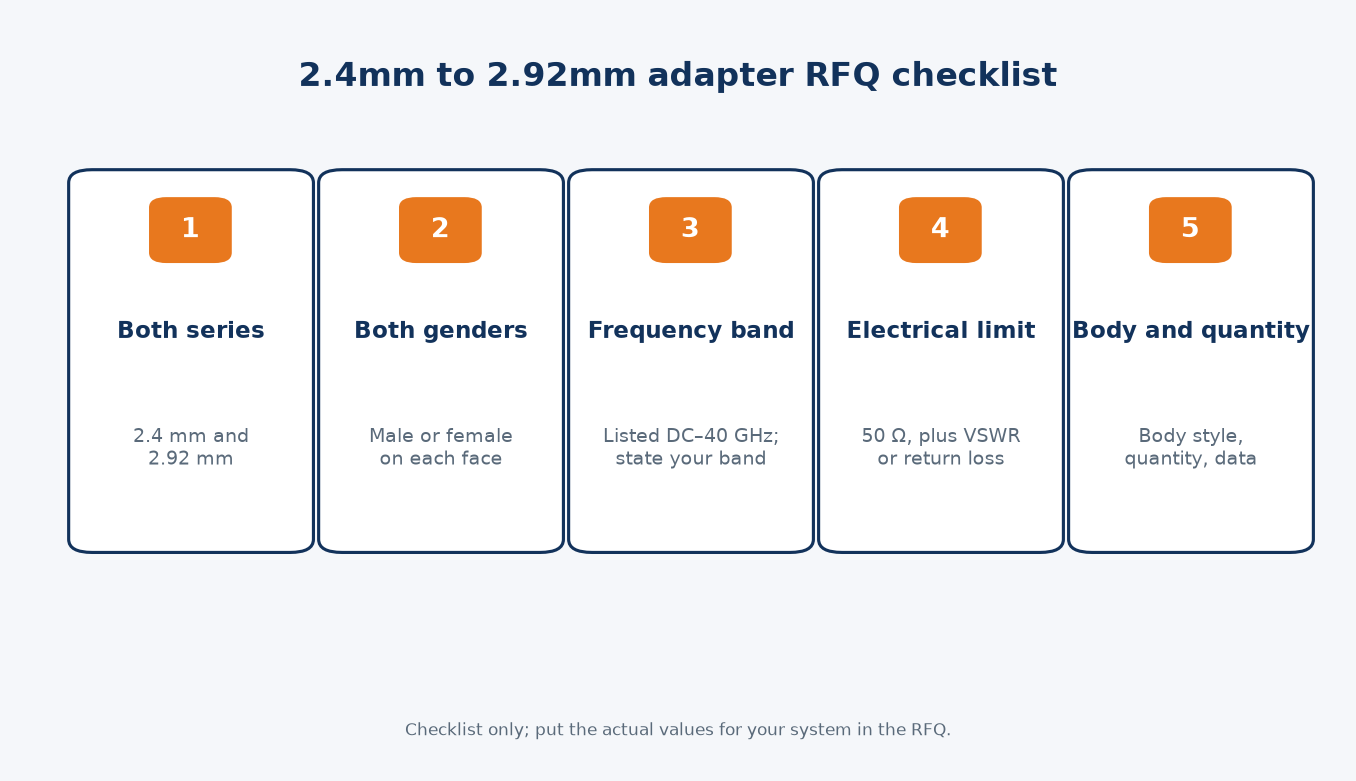
A checklist you can paste into the RFQ
I group the request into interface, electrical, mechanical and records. Interface is the pair of faces, written out (for example “2.4 mm male to 2.92 mm female”), not just “2.4 to 2.92”. Electrical is 50 Ω impedance, the band, and the reflection limit across that band. Mechanical is body style and, if you care, materials; our catalog parts use passivated stainless steel and gold-plated contacts, with a PEI insulator. Records are whether a typical test plot is enough or you want data with each unit.
| RFQ line | What to state |
|---|---|
| Interfaces | 2.4 mm and 2.92 mm, with gender on each side |
| Electrical | 50 Ω, band, VSWR or return loss |
| Body | Straight, or bulkhead / right-angle if needed |
| Environment | Temperature, any panel or sealing data |
| Quantity and data | How many, and what plots or certs |
If the system must remain at 50 GHz, say that clearly so we do not quote a 2.4mm to 2.92mm adapter by habit. NASA-STD-8739.4A reminds assemblers to use the documented mating torque and to turn only the coupling nut. When the list is ready, request a quote and include frequency range, both connector genders, quantity and the application. You can also start from RL-2.4/2.92-JKG and tell us what must change. Our engineers will reply with a part recommendation; please confirm the frequency range and genders before you place the order.
Frequently asked questions
Why is a 2.4mm to 2.92mm adapter limited to 40 GHz? Because the 2.92 mm face, not the 2.4 mm face, sets the ceiling. Our catalog gender pairs are listed DC to 40 GHz. In-series 2.4 mm adapters on the same site are listed DC to 50 GHz.
Are 2.4 mm and 2.92 mm the same interface? No. They have separate IEC sectional standards for their mating faces. A 2.4mm to 2.92mm adapter is the designed transition between those series.
How do I choose the genders? Match each face to the port it must mate: 2.4 mm male to a 2.4 mm female port, 2.92 mm female to a 2.92 mm male cable, and so on. If you are unsure, send photos or part numbers of both sides.
Do you list a 50 GHz 2.4 mm to 2.92 mm adapter? The catalog parts are listed DC to 40 GHz. If you need 50 GHz, keep both ends in 2.4 mm, or tell us the two faces and the required band in the RFQ rather than assuming a higher listing exists.
Conclusion
The 2.92 mm face sets the 40 GHz ceiling; name both genders, and do not treat a 2.4mm to 2.92mm adapter as a 50 GHz part.
STAY IN FOR MORE NEWS
Subscribe to our free newsletter.
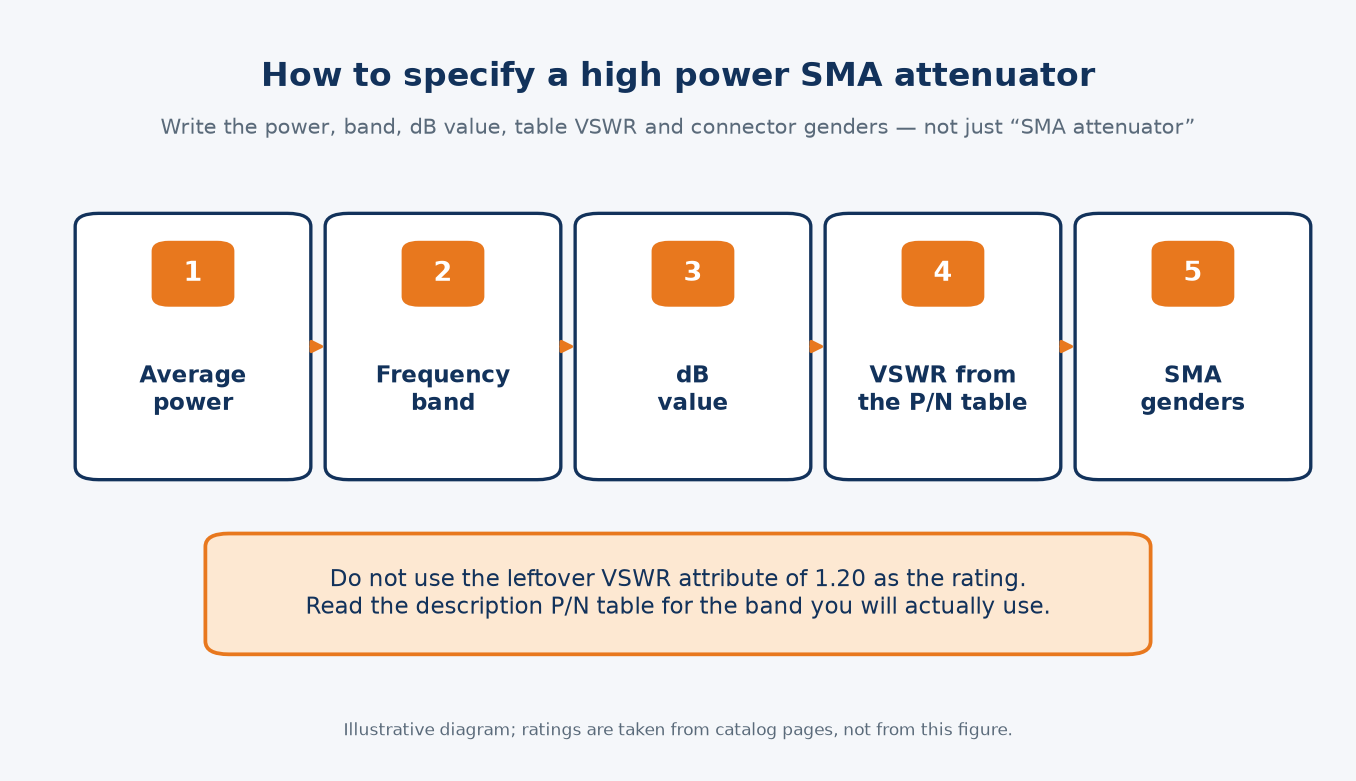
Specify a high power SMA attenuator by average power, band, dB value, VSWR and gender. See catalog 18 GHz options from 2 W to 50 W and an RFQ list.
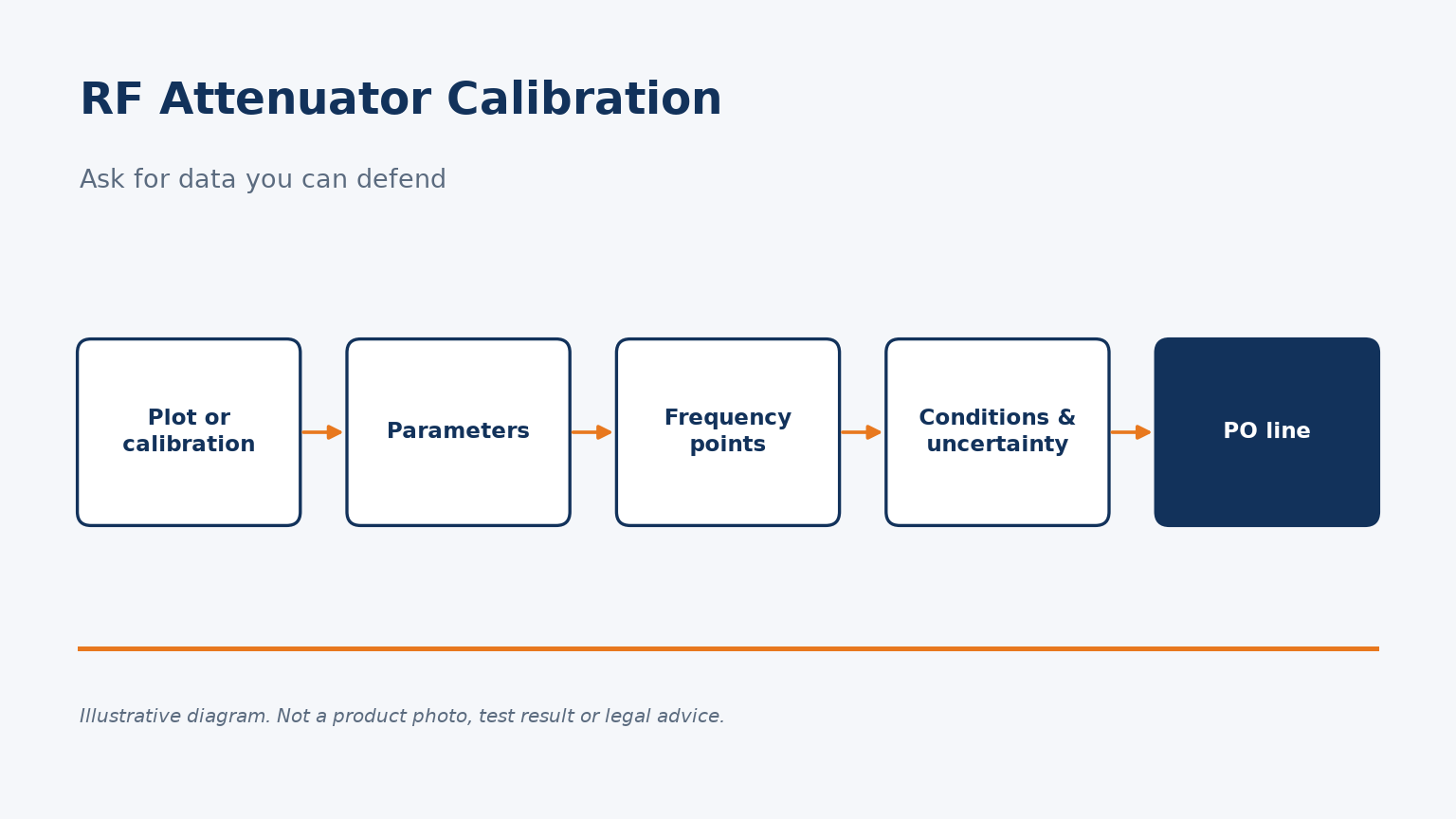
Ask for frequency points, insertion and return loss, and whether you need a factory plot or a lab calibration with your RF attenuator order.
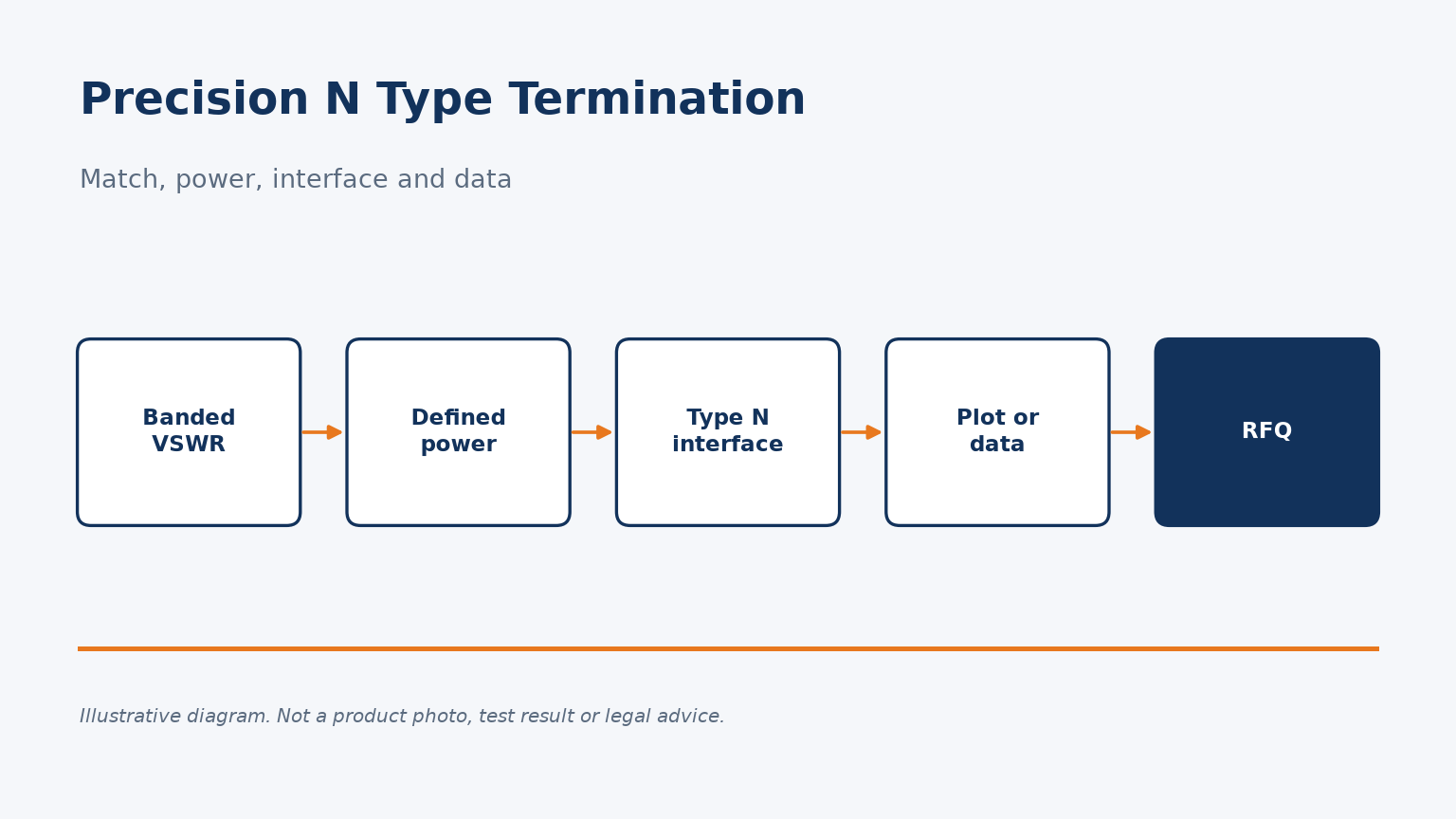
A precision N type termination is defined by banded VSWR, power and data, not a label. See what to request besides a catalog 18 GHz Type N load.
Vibration resistance is not a part number. Specify coupling style, torque, strain relief and the test method in your RF connector or cable RFQ.
