
by Angela
Share
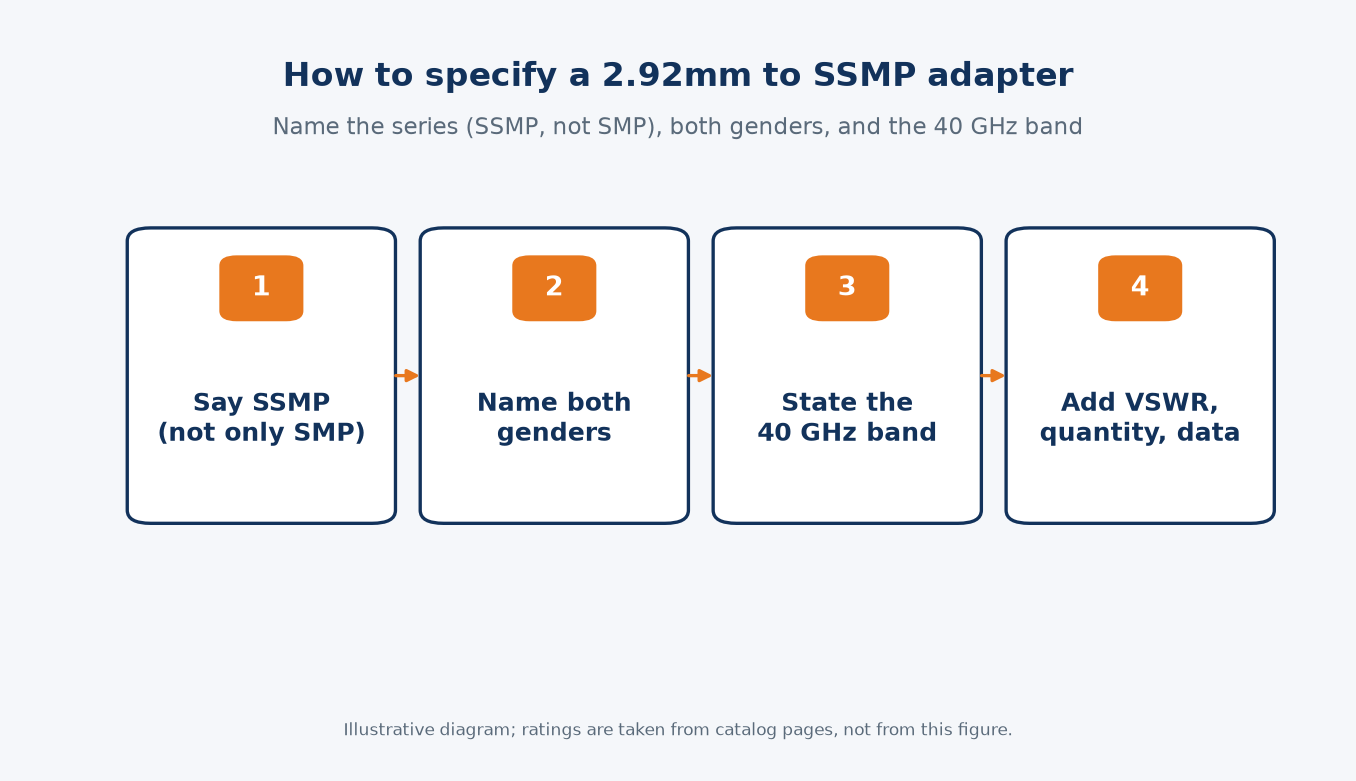
Ordering a 2.92mm to SSMP adapter as a generic “2.92 to SMP” part is how an SMP quote arrives for a board that actually needs SSMP.
Specify a 2.92mm to SSMP adapter by both genders, the 40 GHz catalog band, and the word SSMP — not SMP — on the push-on face. We list four SSMP gender pairs, and a separate SMP family, all as DC to 40 GHz parts.
Below I walk through genders, the SSMP versus SMP distinction, the listed band and a short RFQ; or start from the 2.92 mm male to SSMP female adapter and tell us which pair you need.
Why is “2.92mm to SSMP adapter” not a complete specification?
The search phrase names two series, but it does not name the two genders that actually have to mate.
A 2.92mm to SSMP adapter is specified by the exact gender pair. We list all four combinations as DC to 40 GHz, 50 Ω, stainless-steel catalog parts with a VSWR attribute of 1.25.
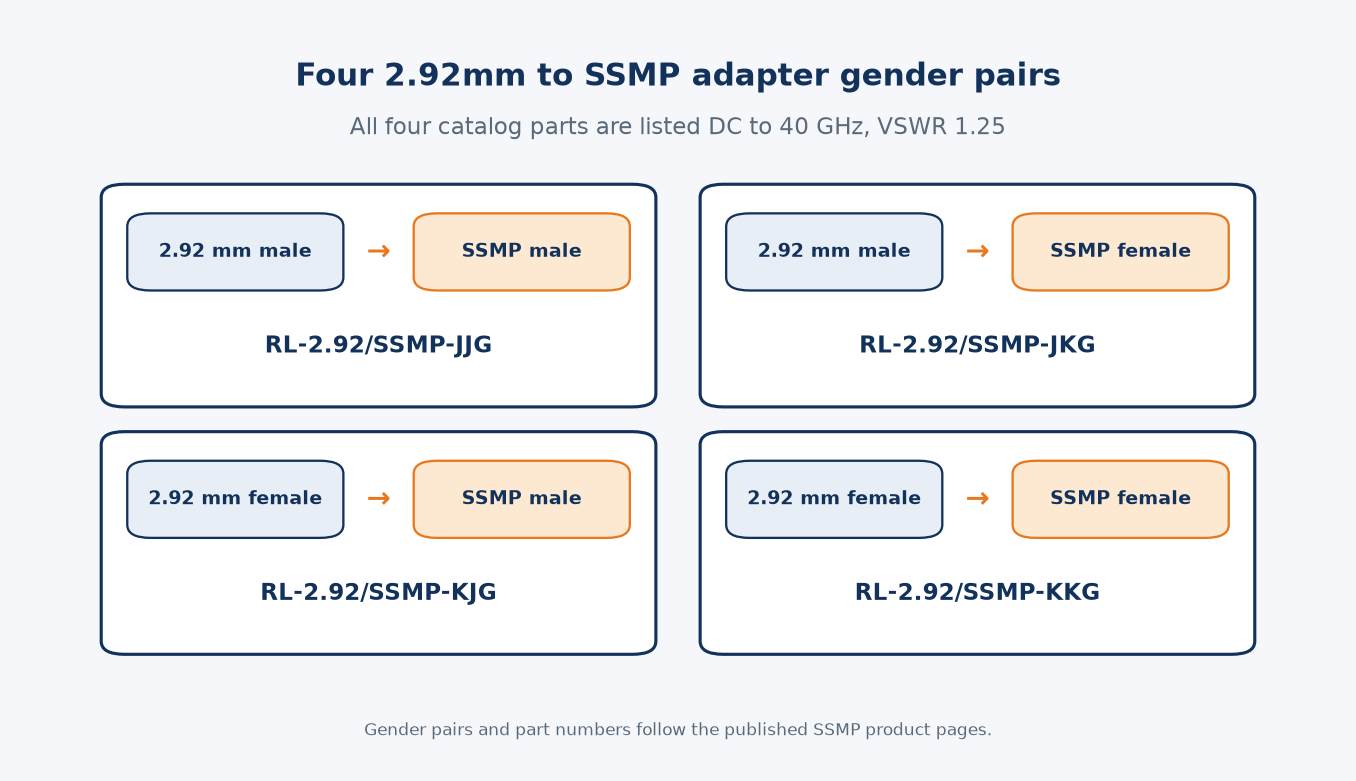
Four combinations, four part numbers
In coaxial hardware, “male” and “female” refer to the contact and the coupling interface, not to the name of the series. A 2.92 mm instrument port that is female needs a 2.92 mm male adapter face; an SSMP board or cable connector that is male needs an SSMP female face. Writing only “2.92 mm to SSMP” leaves four equally plausible parts on the table. A mismatch will not mate, and a gender changer adds another junction.
We publish all four gender combinations as DC to 40 GHz catalog adapters:
| Gender pair | P/N | Product page |
|---|---|---|
| 2.92 mm male to SSMP male | RL-2.92/SSMP-JJG | Product 6365 |
| 2.92 mm male to SSMP female | RL-2.92/SSMP-JKG | Product 6366 |
| 2.92 mm female to SSMP male | RL-2.92/SSMP-KJG | Product 6367 |
| 2.92 mm female to SSMP female | RL-2.92/SSMP-KKG | Product 6368 |
All four listings also give a temperature range of −55 °C to +85 °C, a durability of at least 500 matings, a passivated stainless-steel body (Su303), a gold-plated beryllium-copper inner contact and a PEEK insulator. The VSWR attribute on each page is 1.25. I would still ask for the VSWR or return-loss limit across your actual band, because a single attribute is not a plot.
If you already know the two faces, open the matching SSMP product page or send the pair to us for a quote. Need a straight 2.92mm to SSMP adapter quickly for a 40 GHz path? Start with the four catalog genders above rather than a custom drawing.
Why must the RFQ say SSMP, not only SMP?
SMP and SSMP look like typographic cousins. They are different series, and the listed frequency will not tell them apart.
Name the push-on series in the RFQ. We list a 2.92mm to SSMP adapter family and a separate 2.92 mm to SMP family. Both are published as DC to 40 GHz with a VSWR attribute of 1.25, so the band alone will not distinguish them.
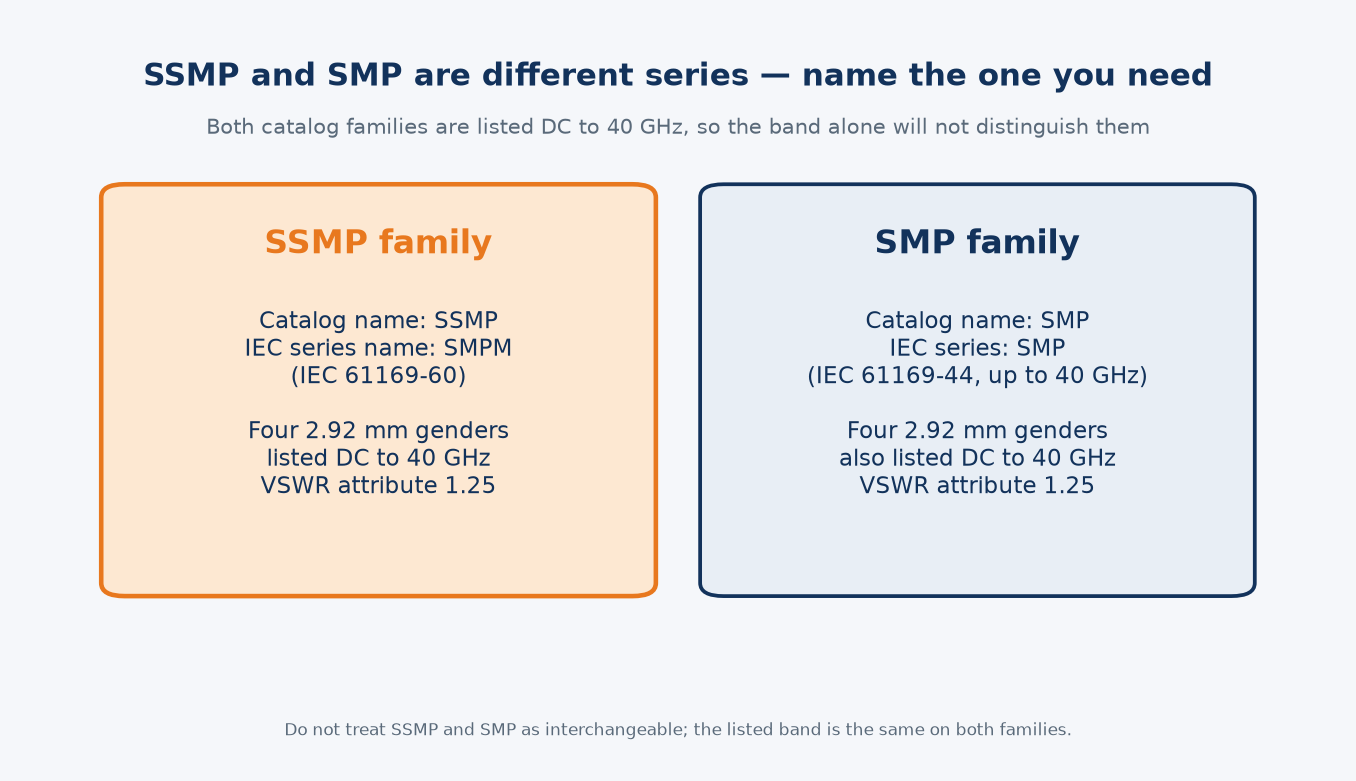
Two families, the same listed band
On this site the SSMP name is the one printed on the four product pages above. IEC 61169-60 is the sectional standard for the smaller push-on series it calls SMPM. I am not going to treat every industry nickname as a legal synonym, but if your drawing says SMPM, say so in the RFQ so we quote the SSMP face and not the SMP face. SMP itself is a different series. IEC 61169-44 is the sectional standard for series SMP push-on connectors, and the official abstract states that the operating frequency limit is up to 40 GHz, with a characteristic impedance of 50 Ω.
We also list four 2.92 mm to SMP catalog adapters, likewise titled DC to 40 GHz, with a VSWR attribute of 1.25:
| Gender pair | P/N | Product page |
|---|---|---|
| 2.92 mm male to SMP male | RL-2.92/SMP-JJG | Product 6364 |
| 2.92 mm male to SMP female | RL-2.92/SMP-JKG | Product 6363 |
| 2.92 mm female to SMP female | RL-2.92/SMP-KKG | Product 6362 |
| 2.92 mm female to SMP male | RL-2.92/SMP-KJG | Product 6361 |
The last of those URLs uses a hyphenated “s-m-p” slug. Confirm the title and the P/N on the page. Because both families share a 40 GHz listing and the same VSWR attribute, a request that only says “2.92 mm to SMP, 40 GHz, VSWR 1.25” can be read as either family. The word SSMP (or SMP, or SMPM if that is what the drawing uses) is the line that makes the quote comparable.
This page is a buyer RFQ for the adapter. For connector-level background on the two push-on families, see the engineering behind SMP and SSMP connectors. That article is the overview; it is not a substitute for naming the adapter genders.
How high in frequency is a 2.92mm to SSMP adapter listed?
Both faces in this catalog family are published to the same band, so the adapter listing is DC to 40 GHz.
Every catalog 2.92mm to SSMP adapter on this site is listed DC to 40 GHz, with a VSWR attribute of 1.25. State your actual band, and do not assume a higher figure than the listing.
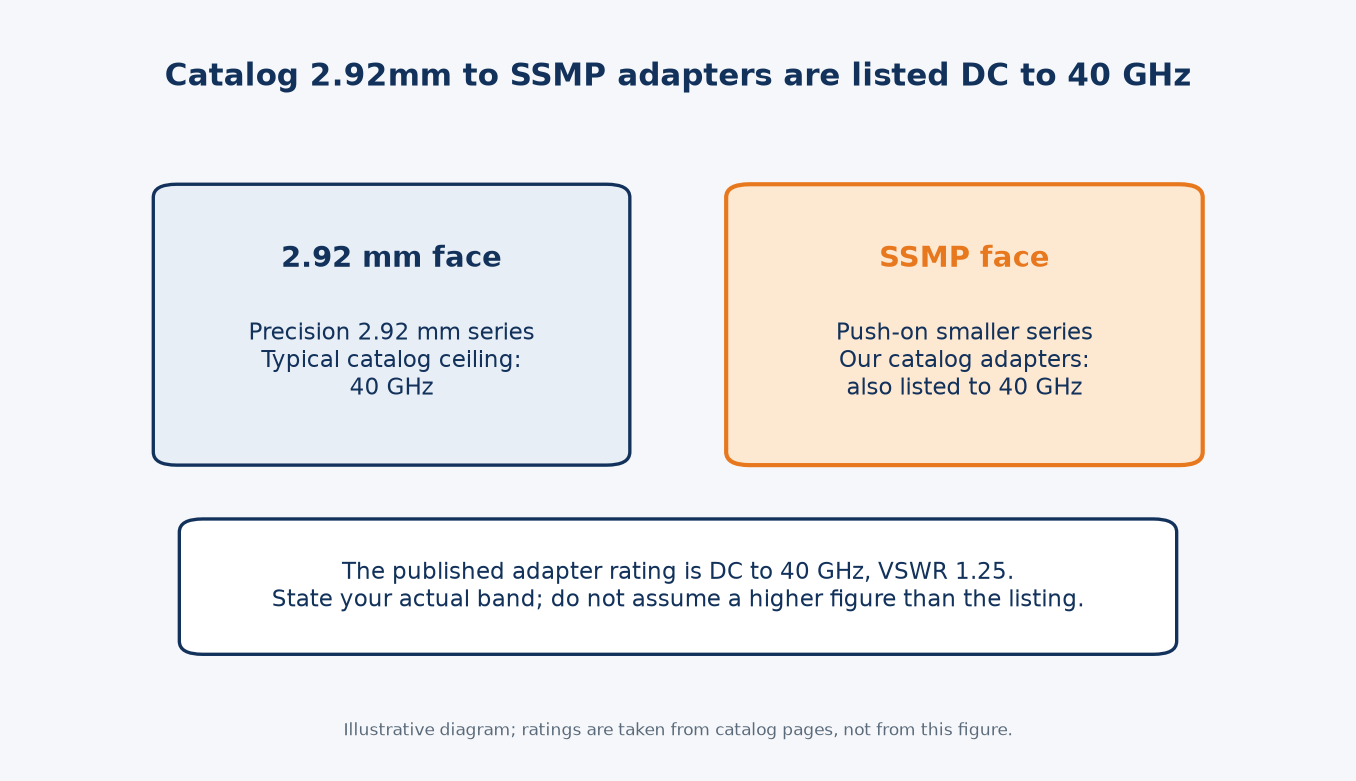
Use the listed 40 GHz band, then state your own
A 2.92 mm precision interface is commonly treated as a 40 GHz-class face in catalog practice, which is why our RF connector frequency range chart places it in that band. The four SSMP adapters follow that ceiling: titles and technical-data lines all say DC to 40 GHz. I will not invent a higher SSMP-only rating for these parts. If your system is already well below 40 GHz, say the real band anyway, so the match can be discussed where you actually work.
IEC 61169-44 states, on its public page, that SMP push-on connectors have an operating frequency limit up to 40 GHz. The IEC 61169-60 abstract for SMPM identifies the series and the mating-face work, but it does not, on the page I opened, publish a frequency limit I can quote. That is another reason I use the catalog listing for the SSMP adapters, and why I want the RFQ to name the series rather than lean on a frequency number alone.
If the mechanical job is not a straight in-line adapter — a bulkhead, a board-mount or a right-angle body — write that down. The four catalog genders are straight between-series parts. I will not treat a different body as a drop-in substitute that is not on the same page. A broader survey of adapter types is in our RF adapter guide. 2.92 mm itself is also discussed, in a different compatibility set, in 2.92 mm vs 3.5 mm vs SMA; that comparison does not replace an SSMP or SMP callout.
One related catalog part is a 2.92 mm male to SSMP female minibend cable assembly, titled DC to 40 GHz. That is a cable, not this adapter. Its WooCommerce attributes still show leftover Frequency=18G and VSWR=1.20 values that do not match the title, so I will not quote those attributes as the assembly rating.
What should a 2.92mm to SSMP adapter RFQ include?
A short, complete request keeps an SSMP quote and an SMP quote from being mixed, and it prevents a wrong-gender delivery.
State SSMP or SMP by name, both genders, 50 Ω, the frequency band (catalog parts are DC to 40 GHz), a VSWR or return-loss limit, the body style, quantity, and any test data you want with the parts.
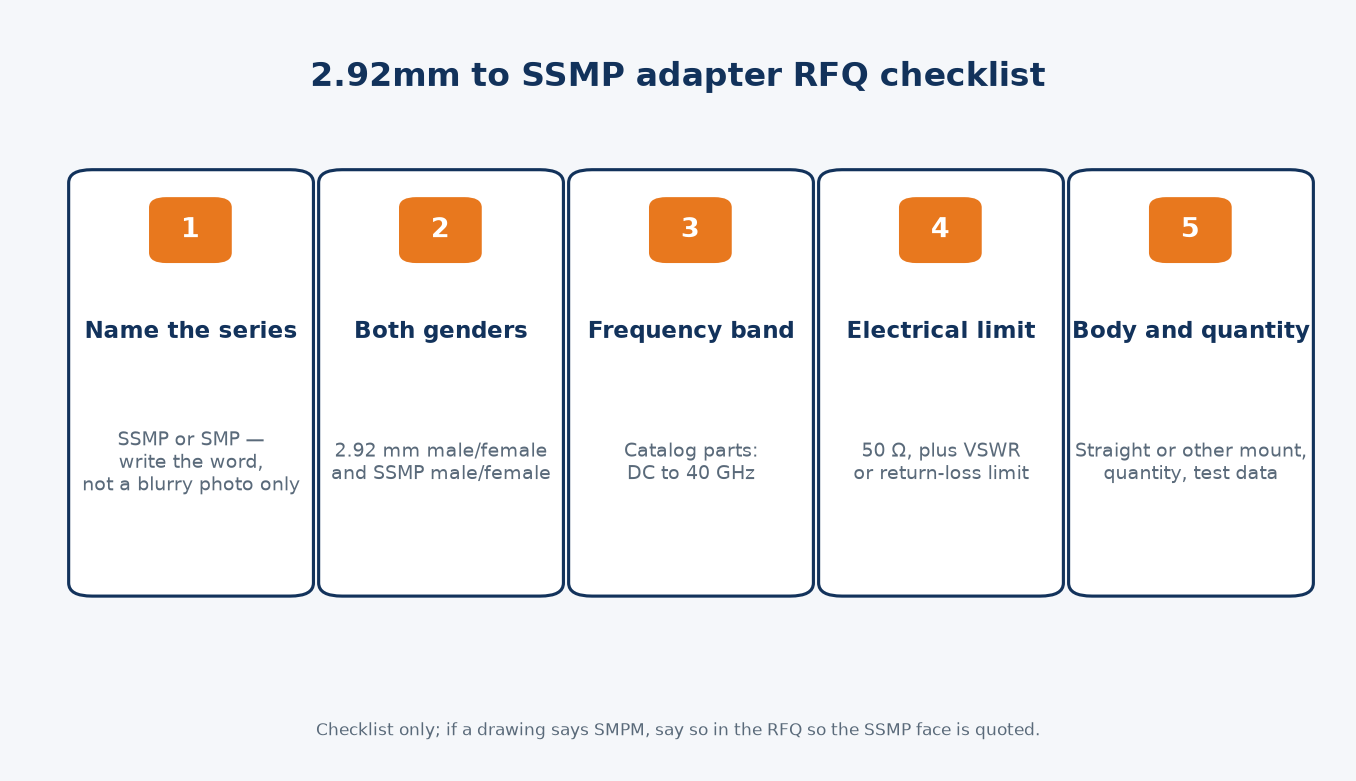
A checklist you can paste into the RFQ
I group the request into interface, electrical, mechanical and records. Interface is the pair of faces, written out (for example “2.92 mm male to SSMP female”), including the word SSMP or SMP, not just “2.92 to mini-SMP”. If the drawing says SMPM, write that too. Electrical is 50 Ω, the band, and the reflection limit across that band. Mechanical is body style and, if you care, materials; our catalog parts use passivated stainless steel, gold-plated contacts and a PEEK insulator. Records are whether a typical test plot is enough or you want data with each unit.
| RFQ line | What to state |
|---|---|
| Series | SSMP or SMP (or SMPM if that is the drawing name) |
| Interfaces | 2.92 mm and SSMP/SMP, with gender on each side |
| Electrical | 50 Ω, band, VSWR or return loss |
| Body | Straight, or another mount if needed |
| Quantity and data | How many, and what plots or certs |
MIL-STD-348 is the interface standard that defines radio-frequency connector mating faces used across many series; it is the right reference if you need the interfaces controlled to a published dimensional standard. NASA-STD-8739.4A reminds assemblers to use the mating torque from the engineering documentation and to turn only the coupling nut. NIST work on coaxial connector repeatability is also a reminder that each extra mated pair is not electrically free. When the list is ready, request a quote and include frequency range, both connector types and genders, quantity and the application. You can also start from RL-2.92/SSMP-JKG and tell us what must change. Our engineers will reply with a part recommendation; please confirm the series, frequency range and genders before you place the order.
Frequently asked questions
Is a 2.92mm to SSMP adapter the same as a 2.92 mm to SMP adapter? No. They are different catalog families. Both are listed DC to 40 GHz with a VSWR attribute of 1.25, so you must name SSMP or SMP in the RFQ.
What frequency is a 2.92mm to SSMP adapter? The catalog parts on this site are listed DC to 40 GHz. Do not assume a higher rating than the listing.
How do I choose male or female? Match each face to the port it must mate. If you are unsure, send photos or part numbers of both sides, and say whether the push-on side is SSMP or SMP.
What if my drawing says SMPM? Put that name in the RFQ so we can quote the SSMP family rather than the SMP family, and confirm the genders against the drawing.
Conclusion
Name SSMP rather than SMP, write both genders, and treat a 2.92mm to SSMP adapter as a 40 GHz catalog part.
STAY IN FOR MORE NEWS
Subscribe to our free newsletter.
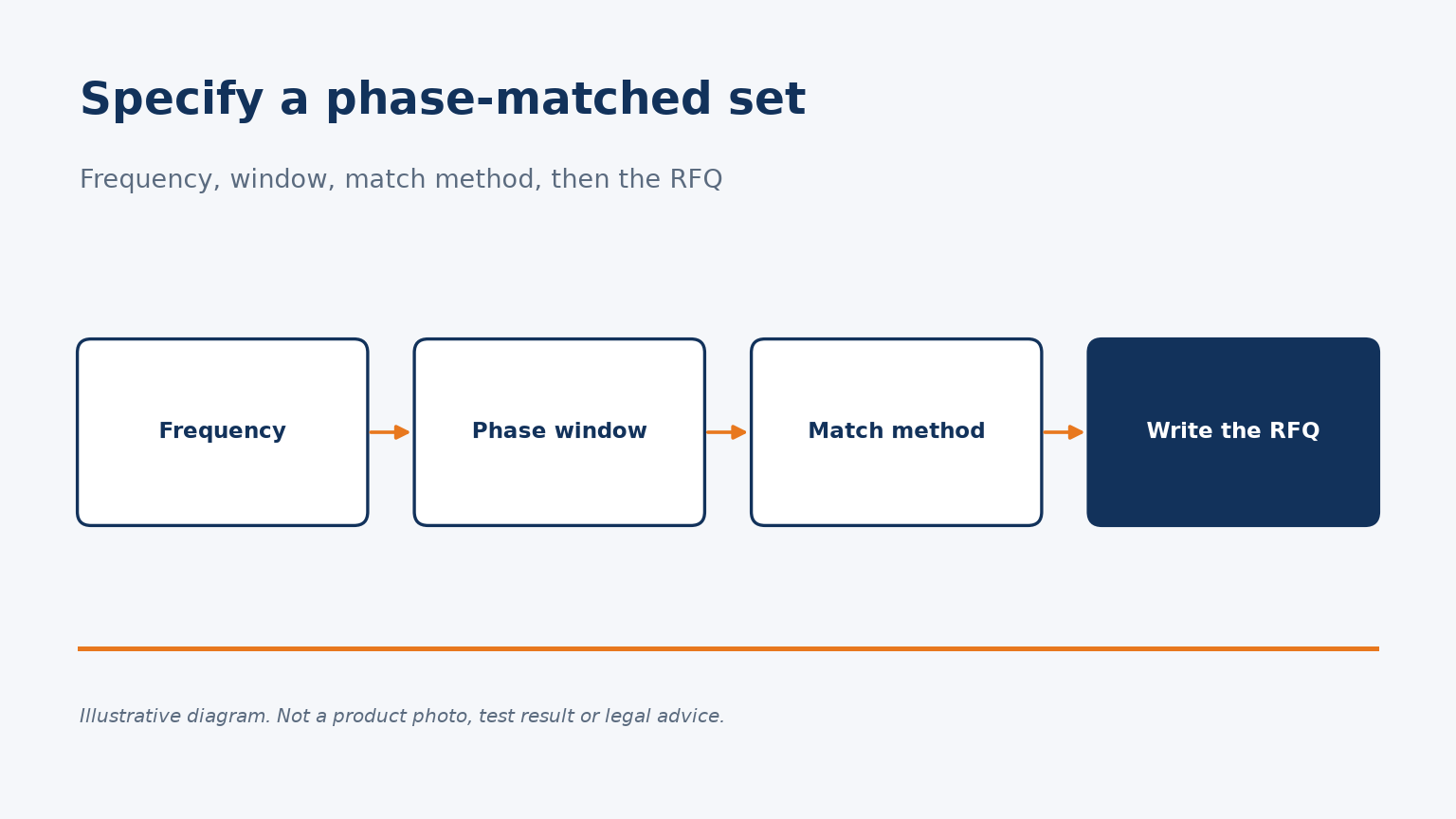
A phase matched cable assembly RFQ should name frequency, the phase window, match method, connectors and length. See a 67 GHz catalog example.
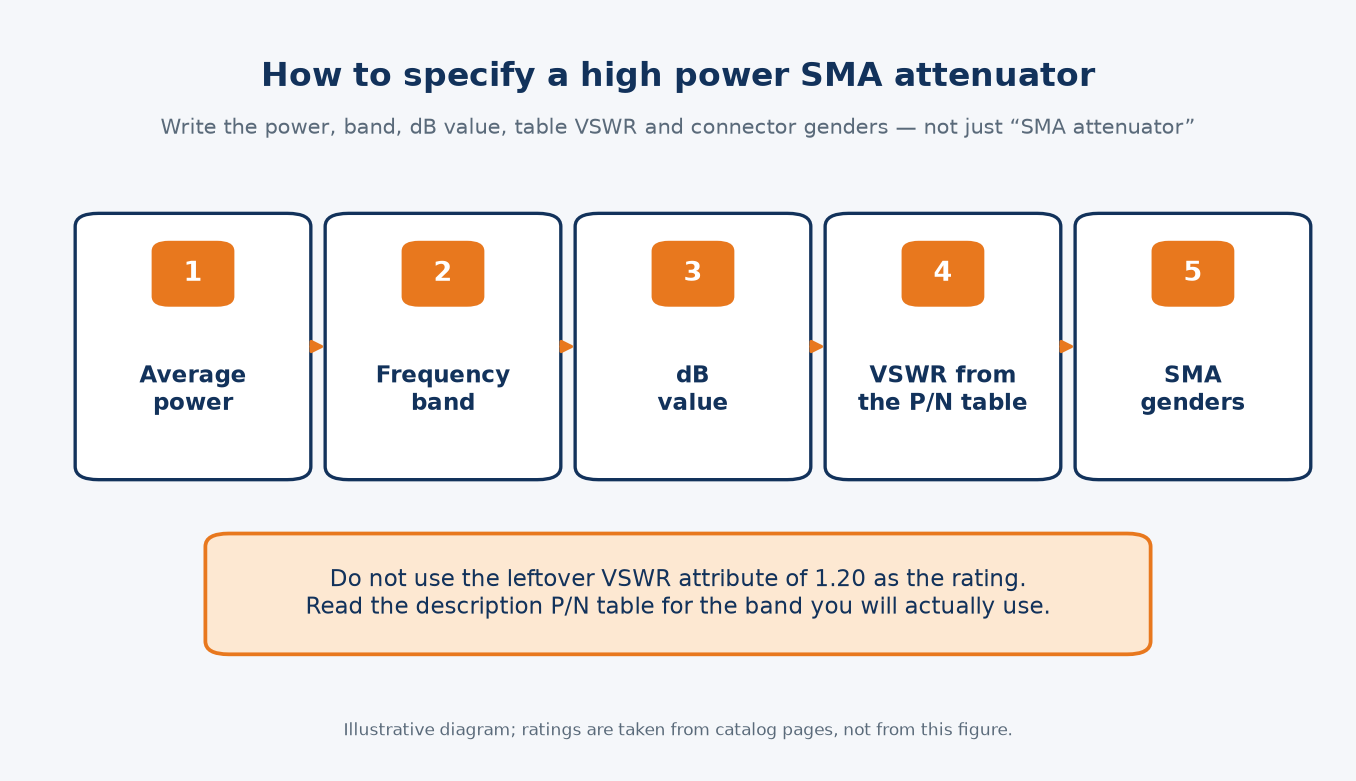
Specify a high power SMA attenuator by average power, band, dB value, VSWR and gender. See catalog 18 GHz options from 2 W to 50 W and an RFQ list.
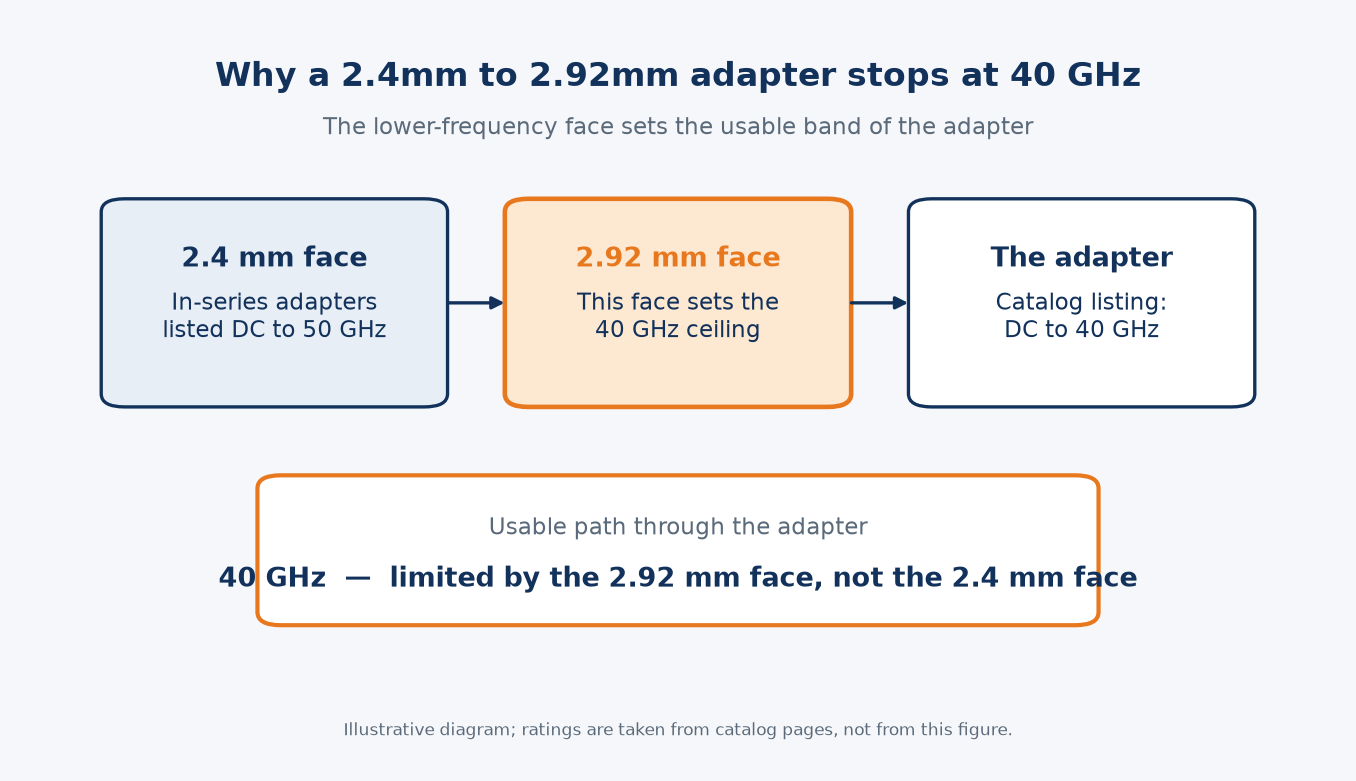
A 2.4mm to 2.92mm adapter is limited by the 2.92mm face, so catalog parts are listed DC to 40 GHz. See four gender pairs and a short RFQ checklist.
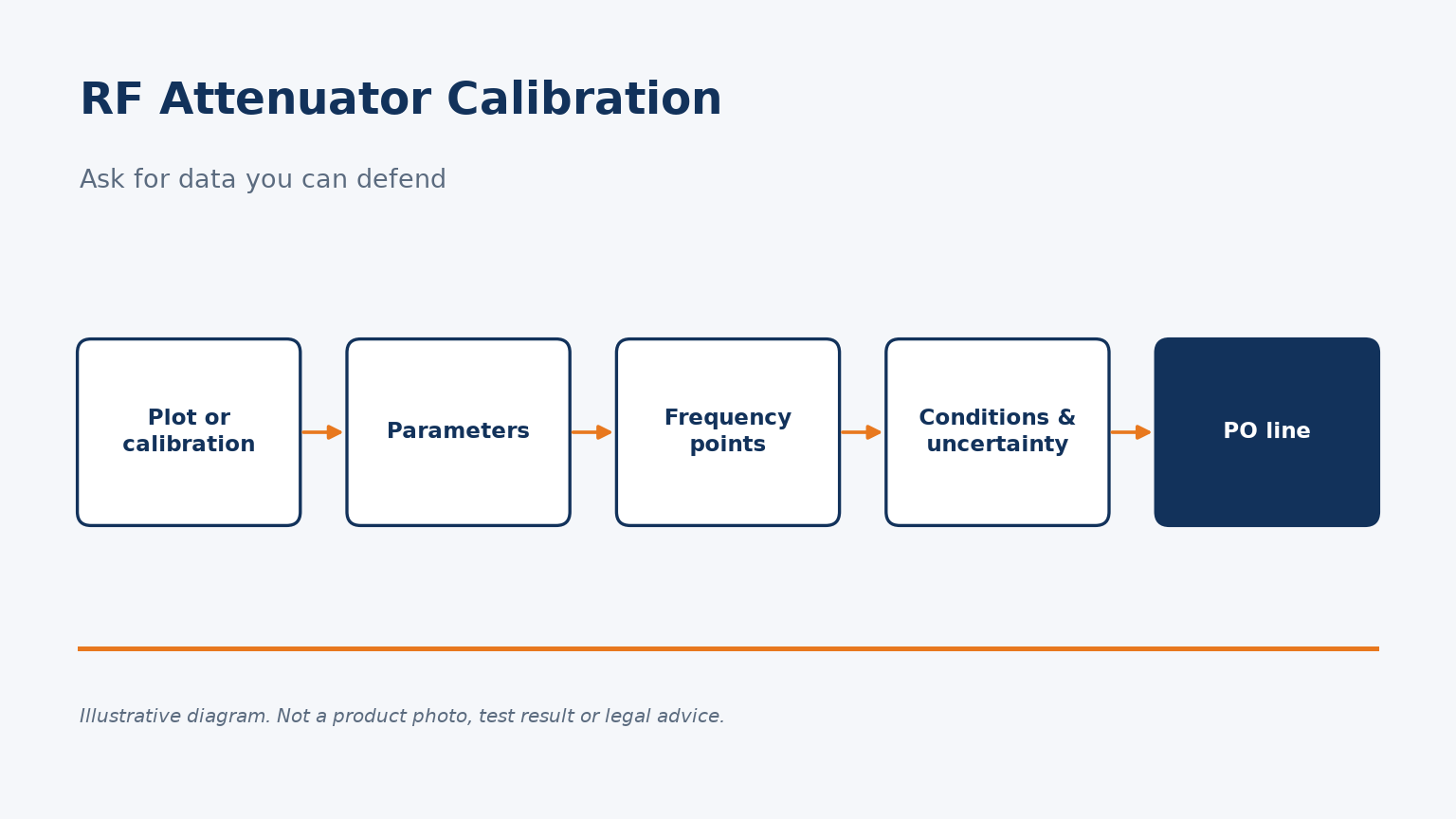
Ask for frequency points, insertion and return loss, and whether you need a factory plot or a lab calibration with your RF attenuator order.
